


Rahul Gandhi, Kharge remember Bhagat Singh on birth anniversary, highlight his courage and ideals
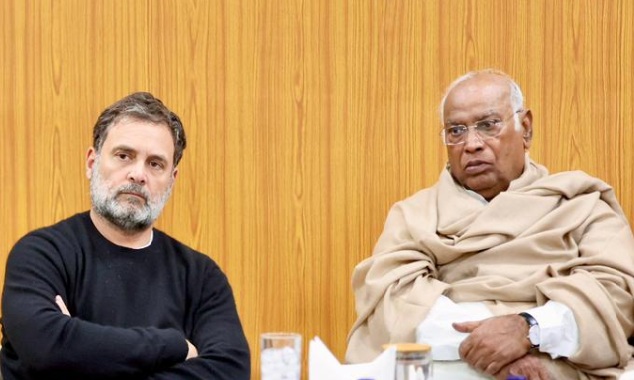
New Delhi, Sep 28 (UNI) Congress leader and Leader of the Opposition in the Lok Sabha Rahul Gandhi and Congress president and Leader of the Opposition in the Rajya Sabha Mallikarjun Kharge on Monday paid tribute to legendary revolutionary and freedom fighter Shaheed-e-Azam Bhagat Singh on his birth anniversary, recalling his courage, sacrifice and contribution to India's freedom struggle.
In separate posts on social media platform X, Gandhi and Kharge remembered Bhagat Singh as a towering figure of India's anti-colonial movement and highlighted the continuing relevance of his ideas and ideals, particularly for the younger generation. Rahul Gandhi said Bhagat Singh's struggle for India's freedom, his indomitable courage and his supreme sacrifice would remain a source of inspiration for generations to come. "On the birth anniversary of the great revolutionary Shaheed-e-Azam Bhagat Singh, I pay my respectful tributes to him," Gandhi said, adding that his struggle for India's independence, his unwavering courage and his supreme sacrifice would always inspire the people of the country. Kharge, in his tribute, recalled Bhagat Singh's revolutionary spirit and quoted lines attributed to the freedom fighter: "I am writing the conclusion of which… tomorrow will bring its beginning.
Every drop of my blood will bring revolution." Paying homage to Bhagat Singh, Kharge said the revolutionary had devoted his entire life to the cause of India's freedom. He also emphasised that Bhagat Singh's contribution went beyond his struggle against British colonial rule, pointing to his writings and ideas on social inequality and the forces that sought to divide society. "Bhagat Singh did not merely struggle against British rule; through his pen and ideas, he also raised his voice against social inequality and forces that divide society," Kharge said. He added that Bhagat Singh's courage, ideological conviction and vision of a just society continued to inspire millions of young people.
Bhagat Singh was born on September 28, 1907, in Banga village in present-day Faisalabad district of Pakistan, then part of undivided Punjab. He emerged as one of the most prominent young revolutionaries of India's freedom movement and became an enduring symbol of resistance to British colonial rule. His revolutionary activities and writings reflected a broader political and social vision. Bhagat Singh argued that political independence could not be separated from the struggle against exploitation and inequality, and his association with the Hindustan Socialist Republican Association reflected his commitment to revolutionary social change. Among his best-known writings is Why I Am an Atheist, in which he set out his views on reason, faith and his own intellectual journey. His writings and political arguments have continued to attract scholarly and public attention long after his death. Bhagat Singh, along with fellow revolutionaries Shivaram Rajguru and Sukhdev Thapar, was executed by the British authorities in Lahore on March 23, 1931, in connection with the Lahore Conspiracy Case.
He was only 23. The three revolutionaries came to occupy a central place in India's freedom movement and are remembered together as Bhagat Singh, Rajguru and Sukhdev. March 23 is observed as Shaheed Diwas in their memory. Bhagat Singh's legacy has subsequently extended beyond the circumstances of his death, with his name becoming closely associated with courage, sacrifice, intellectual inquiry and resistance to colonial rule. His writings and political thought have also remained part of discussions on social justice, equality and the responsibilities of a free society.
The birth anniversary tributes from Gandhi and Kharge therefore focused not only on Bhagat Singh's supreme sacrifice for India's independence but also on the wider ideas associated with his life and writings, particularly his emphasis on courage, equality and social justice.
UNI SKA ATP


