


Abbas tells UN Palestinian delegation was 'unlawfully' denied visas, warns 'we will not accept displacement'
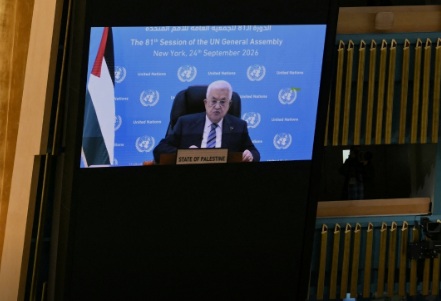
New York, Sep 24 (UNI) Palestinian Authority President Mahmoud Abbas on Thursday charged the United States with "unlawfully" denying visas to the Palestinian delegation for a second consecutive year, while telling the UN General Assembly that Palestinians faced "one of the most dangerous times" in their history amid the Gaza war and escalating settlement activity in the occupied West Bank.
Addressing the General Assembly by a pre-recorded video after the Trump administration refused to grant him a visa to attend in person, he rejected "unlawful punitive measures" and denied US accusations against the Palestinian Authority and Palestine Liberation Organisation of failing to meet their commitments, including allegations tied to International Criminal Court and International Court of Justice actions.
Abbas said the Palestinian leadership had carried out a comprehensive reform programme, honoured its international obligations, rejected violence and terrorism, and remained committed to a two-state solution.
"For the second consecutive year, the Palestinian delegation was denied the entry visas required to reach New York and participate in the meetings of the United Nations General Assembly in person," he said, adding, "We reject these unlawful punitive measures, and we reject the accusations and justifications on which they were based."
The US State Department has accused the Palestinian Authority and PLO of failing to meet their commitments, including by seeking to "internationalise the Israeli-Palestinian conflict" through the International Criminal Court and International Court of Justice, as well as "glorifying terrorism".
Dismissing those allegations, he said the Palestinian leadership had "fulfilled obligations" and carried out a comprehensive reform programme while maintaining its commitment to international law, rejecting violence and terrorism and supporting a two-state solution."
Describing the current period as among the most perilous in Palestinian history, Abbas detailed widespread destruction in Gaza - hospitals, schools, mosques and churches among the damage - and said Israeli military operations amounted to a humanitarian catastrophe. He also pointed to accelerating settlement expansion in the West Bank, including East Jerusalem, alongside rising settler violence, land seizures and home demolitions.
He said Palestinians were enduring "one of the most dangerous times of their history", accusing Israeli forces of killing, destruction, starvation and attempts at displacement.
"Our people are being subjected... to killing, destruction, starvation and attempts at displacement, as well as a genocidal war that has created an unprecedented humanitarian catastrophe," Abbas said.
He accused Israel of destroying neighbourhoods, cities, refugee camps, institutions, schools, universities and hospitals, while alleging that settlement expansion and settler violence were accelerating in the West Bank, including East Jerusalem.
Scathing in his criticism of Israel's policies, he accused the Jewish state of seeking to "expand its colonial project towards establishing the so-called Greater Israel and completely erasing Palestinian presence".
Turning to Gaza, he welcomed the international framework for implementing the second phase of the peace plan but warned that progress was falling far short of expectations.
"Regretfully, we have not seen any of this materialise on the ground," he said, adding that Israeli military operations continued to kill civilians in Gaza. Calling for the second phase to be accelerated, he warned that the transitional period must not become "a permanent or open-ended situation" without a clear political timetable.
He said Gaza must ultimately be reunited with the West Bank, including East Jerusalem, under Palestinian authority, based on "one state, one government, one law, and one legitimate entity authorized to bear arms".
He also warned against attacks on Islamic and Christian holy sites, saying such actions could trigger "a broader religious conflict in the region and beyond".
Abbas urged the international community to enforce UN Security Council Resolution 2334, which calls for an end to Israeli settlement activity in occupied Palestinian territory, including East Jerusalem.
While welcoming President Trump's 20-point Gaza peace plan and the associated UN Security Council resolution, Abbas said implementation remains stalled for nearly a year, with only one year left before the transitional period is due to end in 2027. He particularly appealed to US President Donald Trump to honour commitments made to Arab and Islamic leaders to prevent the annexation of Palestinian land and reject displacement.
"It is impossible to separate Israel's land seizure practices from the dismantling of Palestinian institutions and the depletion of its financial resources," Abbas said, claiming that more than $6 billion belonging to the Palestinian people was being withheld by the Israeli government.
Abbas demanded the immediate release of the funds and an end to financial and economic restrictions on the Palestinian Authority. He credited the UK and a dozen other countries with measures supporting the two-state solution, including bans on settlement products, and welcomed a proposed summit on the issue floated by France, the UK and Canada.
Abbas also said local council elections had already taken place, while legislative elections were scheduled for November 28, followed by steps toward renewing the Palestinian National Council and holding presidential elections.
Reiterating his commitment to a two-state solution, Abbas said Palestinians sought a "non-militarized state" living alongside Israel in peace and security.
But he delivered a defiant message on displacement.
"The Palestinian people will remain on its land," he said. "The Palestinian people will not accept displacement, will not accept displacement, and will not disappear."
Neither occupation, settlement expansion, annexation nor settler violence could provide lasting security, he made it clear. "No lasting security can be built upon the occupation of another people and the denial of its legitimate rights," Abbas said.
He called for an independent Palestinian state with East Jerusalem as its capital and urged countries that have not recognised Palestine to do so. He also renewed the call for full UN membership for the State of Palestine, saying 160 countries had now recognised it.
"We will not leave our homeland. We will not accept displacement, and we will not allow anyone to decide our future on our behalf," Abbas said in his closing remarks. "We decide for ourselves."
He said Palestinians remained committed to peace based on international legitimacy and a future in which Israelis and Palestinians could live "in security, peace, and good neighborliness".
Abbas also pointed to governance and anti-corruption measures, a new social welfare system and education reforms developed with UNESCO as evidence of progress on Palestinian reform pledges.
UNI AAB MCR


