


Rajeev Ram flags 'genetics' as factor in physical challenge facing Indian tennis
BD Narayankar
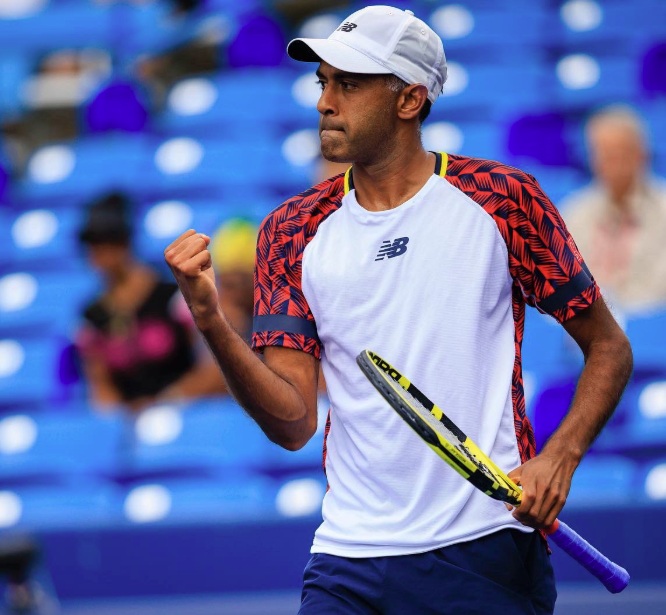
Bengaluru, Sept 21 (UNI) Tennis, like life, has never been entirely fair. And Rajeev Ram, who has spent more than two decades discovering precisely how unfair it can be, believes Indian players have one more handicap to contend with: the modern game has become a physical business.
Ram, the recently retired six-time Grand Slam champion and former world No. 1 doubles player, said the emphasis in tennis has steadily shifted from finesse and technique towards strength, speed and physical endurance.
"The game now has become more physical and less technical and less about, let's say, the skill-based portion of it than it ever was," Ram said replying to a couple of UNI questions at this felicitation ceremony held by Karnataka State Lawn Tennis Association here on Monday. And then came the line that is likely to make Indian tennis sit up. "I think Indians in general are better with the skill side of it than the physical side. So let's just say the deck is stacked against us a little bit," he said. It was, however, not an invitation to Indian players to blame their genes, their ancestors or their mothers. Ram immediately qualified his observation.
Physical limitations, he said, may exist, but they should never become an excuse for not becoming the best player one can be. "I do think it does play a big role. However, I also think that using that as an excuse ... is not the right mentality," he said. "It may be the truth and it may be the case, but I think it's short-sighting yourself if you feel like that's why maybe you weren't as good as you could have been." There is a more encouraging side to his assessment.
Ram believes Indians possess two commodities that cannot be bought in a gym: an eye for the game and an unusually stubborn mentality. "Every Indian that I've played against has had an unbelievable mentality and an eye for the game," he said. That, in his view, can take a player a long way. The problem may begin before the player reaches the professional circuit. Ram, who grew up in the United States, said he has seen a striking rise in the number of Indian-American children taking up tennis, but far fewer making the difficult journey from junior competition to professional sport. Part of the problem, he suggested, is a familiar Indian bargain: education first, sport if there is time left over.
"Education is incredibly important," Ram said, adding that at some point a young player who wants to become a professional has to make a choice. He also acknowledged a cultural hesitation about pursuing sport at the highest level. "Sometimes it's just not in our culture to pursue sport at the highest level always," he said. Ram knows something about making that choice.
He grew up wanting to be a singles player, won two ATP singles titles and eventually switched his priorities towards doubles when he was around 33, choosing a longer doubles career over another year or two in singles. It proved to be a rather good decision. He won six Grand Slam titles, became world No. 1 in doubles and, in 2022, achieved what he called the most meaningful triumph of his career: defending the US Open title and waking up the following Monday as the world's top-ranked doubles player. But Ram's most interesting contribution to Indian tennis may come after his playing days.
He has already been mentoring Nishesh Basavareddy, whom he has known since the youngster was eight, and runs a foundation that provides scholarships to children entering tennis and financial support to a high-performing player. Now he is willing to look towards India.
"I'd certainly be interested and open to thinking about something that can be done if I can help in any way because it is important to me," Ram said. Nothing, he stressed, has been arranged. But nothing is ruled out either.
"Nothing is set in stone at the moment, but it's certainly not out of the question." For a country that has produced Rohan Bopanna, Leander Paes and Mahesh Bhupathi, Ram does not believe the next doubles No. 1 is an impossible proposition. Rankings, he said, move in cycles. The greater challenge is finding the child willing to endure the long years required to make the cycle turn again. Ram's advice is almost disarmingly simple. Look for obsession. "The kids that I've seen that have,
I think, the best potential and the best chance are the ones that really - it's almost like they have an obsession with the sport," he said. And perhaps that is where Indian tennis should begin: not with genetics, not with rankings and certainly not with excuses. "Try to be better today than you were yesterday," Ram said. A six-time Grand Slam champion could hardly have left Indian tennis with a simpler prescription.
UNI BDN


