


Centre, states must work together to boost farmers' incomes: union Minister Chouhan
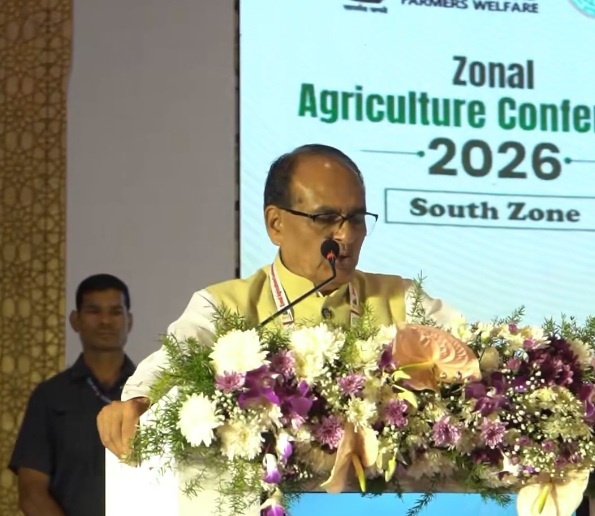
Hyderabad, Sept 18 (UNI) union Minister for Agriculture & Farmers Welfare Shivraj Singh Chouhan, on Friday stressed the need for Centre-State cooperation to address region-specific agricultural challenges and increase farmers' incomes.
Addressing the Regional Agriculture Conference for Southern States here, Chouhan said the Centre does not approach agricultural issues based on which political party is in power in a state and that "Nation First" is the guiding principle. The conference discussed the impact of El Niño, crop diversification and preparations for the upcoming Rabi season. Chouhan said the deliberations were aimed at bringing tangible improvements in farmers' lives, strengthening food security, creating employment opportunities through agriculture and giving fresh momentum to the economy.
"Machines can make bread, but they cannot grow wheat," he said, stressing that agriculture would remain indispensable despite advances in artificial intelligence, machine learning, robotics and other technologies. He identified food security, farmers' livelihoods and nutritional security as the three key goals of Indian agriculture. Chouhan said India cannot afford to depend on other countries for its food requirements and stressed the need to ensure that farmers who feed the nation also lead secure and prosperous lives.
He highlighted the potential of southern India in horticulture, particularly in spices, coffee, cashew, cocoa and sandalwood, and called for measures to maximise benefits for farmers. The union Minister said regional agriculture conferences were essential as states have different agro-climatic conditions, soil characteristics, water availability and resources. "It is not possible to sit at one place for a day and prepare a common Rabi or Kharif plan for the entire country," he said. Chouhan urged state governments to review outdated Acts, laws and procedures and come forward with suggestions wherever changes were required.
"Rules are meant for people; people are not meant for rules," he said, adding that the Centre would undertake necessary reforms at its level while states should make changes within their jurisdiction. He said Prime Minister Narendra Modi had emphasised that government should be visible in people's lives and not remain confined to files. The union Minister said states should learn from one another's best practices and work with the Centre to prepare an agricultural roadmap suited to regional requirements.
"The Government of India will support the states with full strength. Land is with the states, farmers are in the states, and the Centre will provide all possible support. Both must work together," he said. Highlighting the coconut sector, Chouhan said India's coconut exports increased from Rs 4,349 crore to Rs 7,038 crore in one year, registering a 62 per cent growth. He said a new scheme for promotion of coconut announced in the Budget was set to become operational and urged southern states to prepare to take advantage of it. He also called for phased rejuvenation of old coconut plantations and asked states to prepare in advance for promotion schemes for cashew and cocoa.
On Free Trade Agreements, Chouhan said the agreements entered into by India had opened opportunities for agricultural exports to international markets. He called for identifying products in demand globally and aligning domestic production with international quality standards so that farmers could benefit from expanding markets. "The markets of the world are opening up for India, and this is an opportunity for farmers," he said. Chouhan also said the Centre had released the first instalment for construction of two lakh houses under the Pradhan Mantri Awaas Yojana-Gramin in Telangana.
Construction of the houses would now begin, while beneficiaries living in kutcha houses and identified through the survey would be covered in subsequent phases, he said. The Southern Regional Agriculture Conference brought together representatives of the Centre, southern states and union Territories, agricultural experts, ICAR institutions, progressive farmers and other stakeholders to discuss region-specific agricultural priorities and strengthen coordination for sustainable and resilient agriculture.


