


Kharge's lunch diplomacy seeks to keep INDIA Bloc united, sharpen Congress-SP coordination
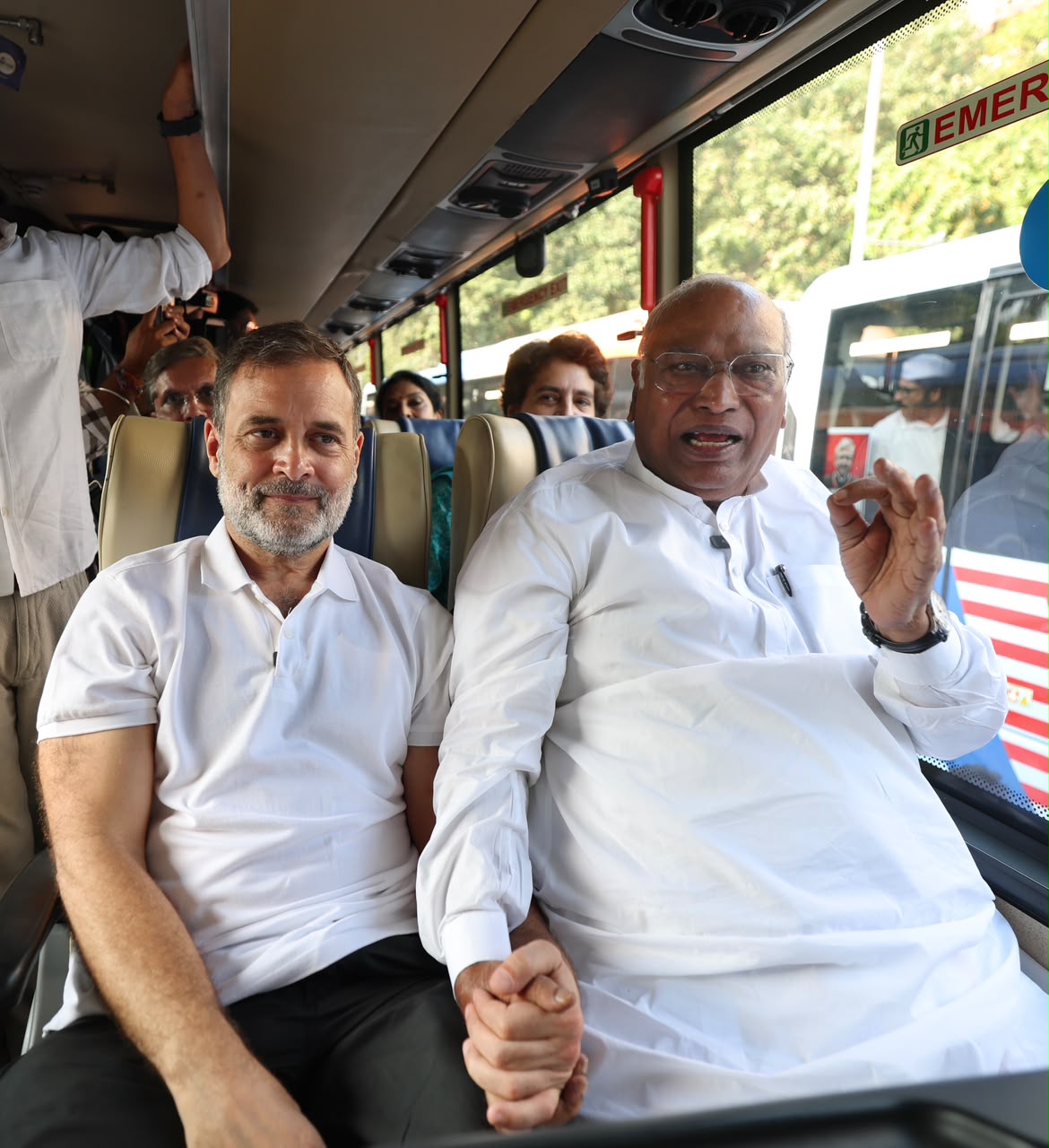
New Delhi, Oct 7 (UNI) Congress president and Leader of Opposition in the Rajya Sabha Mallikarjun Kharge's "lunch diplomacy" at Sagar Ratna on Janpath on Wednesday brought together a broad cross-section of INDIA bloc MPs as the opposition sought to maintain a united front against the Election Commission while simultaneously strengthening coordination among key allies, particularly the Congress and Samajwadi Party, ahead of the 2027 Uttar Pradesh Assembly election.
The luncheon came a day after a dramatic confrontation between opposition parties and the Election Commission over allegations of "vote chori", electoral-roll irregularities and the Special Intensive Revision (SIR) of electoral rolls. The gathering served both as a strategy session on the opposition's immediate campaign against the poll panel and as an effort to keep the INDIA bloc politically coordinated at a time when its constituent parties are also preparing for crucial State-level electoral battles.
Opposition MPs discussed their next course of action and the demand for an appointment with Chief Election Commissioner Gyanesh Kumar. During the meeting, MPs signed a joint communication seeking an urgent meeting with the Election Commission to raise their allegations concerning electoral rolls and the SIR exercise. At the same time, the opposition continued to press for action against Kumar, whose resignation has become one of the central demands of the ongoing campaign. The political significance of the lunch, however, extended well beyond the immediate confrontation with the Election Commission.
The participation of Samajwadi Party representatives assumed particular importance against the backdrop of the Congress-SP decision to continue their alliance for the 2027 Uttar Pradesh Assembly election. SP president Akhilesh Yadav has publicly indicated that the alliance will continue, while suggesting that the eventual distribution of seats would be guided by the winnability of individual candidates. Samajwadi Party Lok Sabha member Rajiv Rai, who had also participated in the opposition's mobilisation in Delhi, was among those associated with the day's political activity.
His presence alongside Congress and other INDIA bloc leaders underscored the effort to demonstrate coordination among parties that retain distinct organisational structures and electoral priorities in their respective States. The lunch was followed by renewed opposition mobilisation, with a large number of MPs moving towards Jantar Mantar for another demonstration. The developments came barely 24 hours after Leader of Opposition in the Lok Sabha Rahul Gandhi and Congress general secretary Priyanka Gandhi Vadra led a prolonged protest in central Delhi.
On Tuesday, opposition MPs had attempted to march from Parliament towards the Election Commission headquarters but were stopped by police barricades. Rahul Gandhi and other leaders subsequently staged an over-eight-hour sit-in near Akashvani Bhawan, demanding an opportunity to meet the Election Commissioners. They were later detained and removed from the site by the Delhi Police.
The Congress and its allies have made the demand for action against Gyanesh Kumar a central element of their campaign, linking it to allegations of irregularities in electoral rolls and opposition to the SIR exercise. The Election Commission has rejected allegations of wrongdoing and maintained that the revision process is being conducted within the constitutional and statutory framework governing electoral registration. The latest mobilisation has consequently acquired two parallel dimensions: an institutional confrontation with the Election Commission and an effort to maintain cohesion among opposition parties whose political calculations differ considerably at the State level.
Tuesday's march and Wednesday's lunch provided a common platform for the Congress, Samajwadi Party, Trinamool Congress and Left parties, even though individual constituents have differed at times over the form and intensity of street mobilisation. Congress leaders including K C Venugopal, Manickam Tagore, Imran Pratapgarhi and Imran Masood were among those associated with the gathering. Trinamool Congress's Derek O'Brien and Left leaders P Sandosh Kumar and V Sivadasan were also present, while Rajya Sabha MP Kapil Sibal and Indian union Muslim League MP Haris Beran were among the other opposition figures at the meeting.
The participation of SP leaders was particularly significant because Uttar Pradesh is likely to be one of the principal electoral theatres in which the opposition alliance will be tested next year. The Congress and SP fought the 2024 Lok Sabha election in Uttar Pradesh together, with the SP emerging as the largest constituent of the alliance in the State. Their decision to continue together into the 2027 Assembly election has given the partnership a longer political horizon, although questions of seat-sharing, campaign coordination and organisational roles are expected to remain important.
Akhilesh Yadav's decision last month to launch his PDA Rath Yatra from Rae Bareli, the Lok Sabha constituency represented by Rahul Gandhi, had already placed the Congress-SP relationship under renewed political scrutiny. The SP's PDA formulation, centred on backward classes, Dalits and minorities, remains a key component of its Uttar Pradesh strategy, while the Congress is seeking to rebuild and expand its organisational footprint in the State. The joint agitation against the Election Commission has nevertheless created another arena in which the two parties can work together at the national level. While electoral negotiations in Uttar Pradesh will eventually require detailed discussions, the current confrontation over electoral-roll revision has allowed the Congress and SP, along with other INDIA bloc constituents, to project a common position on what they describe as threats to electoral integrity.
For Kharge and the Congress leadership, bringing a large number of INDIA bloc MPs together after Tuesday's protest and detention episode offered an opportunity to demonstrate that the opposition mobilisation would continue despite police action. For the SP and other regional parties, participation allowed them to remain part of the national opposition campaign while retaining their independent State-level political strategies.
The heavy police deployment around the Janpath restaurant also reflected the possibility that the gathering could quickly lead to another street mobilisation. Buses and barricades were deployed around the venue amid expectations that opposition leaders could subsequently move towards Jantar Mantar or the Election Commission.
The lunch diplomacy came amid a week-long opposition protest programme announced following recent INDIA bloc coordination meetings. While the immediate target remains the Election Commission, the mobilisation is increasingly becoming a test of the opposition's ability to maintain coordination beyond Parliament and translate parliamentary cooperation into sustained political action on the streets.
For the Congress, the participation of the Samajwadi Party is especially significant because Uttar Pradesh will be one of the most closely watched battlegrounds in the 2027 Assembly election. The two parties have publicly signalled their intention to remain together, but the eventual mechanics of seat-sharing, campaign coordination and leadership roles will determine the depth and durability of the partnership.
For now, the campaign against alleged electoral irregularities has provided the Congress and SP with a common political platform. The issue allows both parties to cooperate nationally even as they prepare for a more complicated negotiation over their respective electoral interests in Uttar Pradesh. Kharge's Sagar Ratna lunch, therefore, served a dual purpose: it was a tactical meeting on the intensifying confrontation with the Election Commission and a broader exercise in opposition coordination. With Rahul Gandhi leading the street mobilisation, Kharge bringing together the parliamentary leadership and regional parties such as the SP maintaining their participation, the Congress is seeking to keep the INDIA bloc collectively engaged on the electoral-roll issue. The immediate next step is continued mobilisation and pressure for direct engagement with the Election Commission. But beneath the confrontation over SIR and the allegations of "vote chori" lies a larger political calculation: whether the INDIA bloc can sustain a common national campaign while its constituent parties simultaneously pursue their own electoral interests. That test will be particularly significant in Uttar Pradesh, where the Congress-SP relationship is set to become one of the most closely watched components of the opposition's strategy for the 2027 Assembly election.
UNI SKA AAB


