


Opposition leader Yair Lapid declares 'win on points' for anti-Netanyahu bloc amid beginning of coalition talks
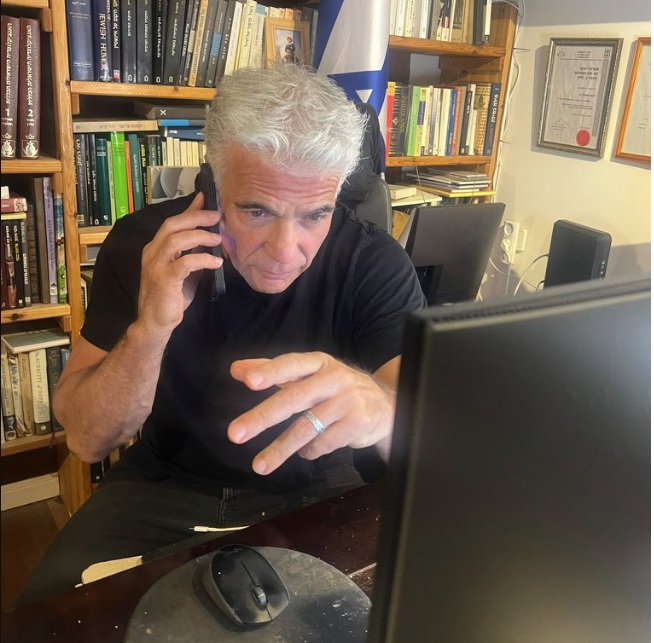
Jerusalem, Oct 30 (UNI) Opposition leader and B'Yachad No. 2 Yair Lapid has described the anti-Netanyahu bloc's performance in Tuesday's election as a "win on points", despite falling short of the 61 seats needed for a parliamentary majority, and urged supporters to be patient as efforts begin to form a government.
"On Tuesday at 22:00, we all stared at the screen and waited for one number. 61. It didn't appear. Not for us, and certainly not for him," Lapid wrote on X on Friday, referring to the number of seats required for a majority in the 120-member Knesset. The anti-Netanyahu bloc secured a combined 67 seats, but its path to power remains complicated by the refusal of three Jewish-led parties - Yashar, B'Yachad and Yisrael Beytenu - to join a coalition with the predominantly Arab Joint List and Ra'am. Netanyahu's bloc won 53 seats, with Likud emerging as the largest party on 27.
The prime minister also lacks a clear route to the 61 seats needed to form a government. Lapid acknowledged that Netanyahu's opponents had hoped for a decisive victory, but argued that the result represented a major setback for the incumbent prime minister. "Netanyahu received 53 seats. A collapse. And even within that low number, 13 of those seats belong to parties that consider themselves non-Zionist," he wrote, referring to the ultra-Orthodox United Torah Judaism and Shas, which won seven and six seats respectively. "He is left with 40. That's what he has. No matter what he does, he doesn't have any way to form a government," Lapid said.
The parties supporting Netanyahu held 68 seats in the outgoing Knesset, making the latest result a substantial decline. "So we won," Lapid said. "It wasn't a knockout; it was a win on points. But points count too. A win is a win." He said the opposition, led by Yashar chairman Gadi Eisenkot, would make every effort to assemble a government, although success was far from certain.
Lapid urged the public to show patience, saying coalition negotiations were conducted privately and could not be rushed for the sake of headlines or political leaks. "Forming a government is the exact opposite" of an election campaign, he wrote, adding that the process took place "in small rooms, slowly, away from the cameras". He acknowledged that uncertainty was difficult for the public but said the opposition needed room to negotiate carefully. "If you want to know whether anything is happening behind the silence you're currently hearing, the answer is yes," he added.
The Jewish-led opposition parties won 48 seats, while the Joint List and Ra'am secured a record 19, almost twice their combined 10 seats in the outgoing Knesset. Yair Golan, leader of the left-wing Democrats party, renewed his call on Friday for the Jewish-led opposition to work with the Arab parties, arguing that excluding their combined 19 seats would undermine democratic representation. "There are no conditional citizens in a democratic Israel," Golan wrote in an opinion piece for Haaretz. "A ballot cast on Tuesday by an Arab citizen in Sakhnin or in Rahat is worth exactly as much as a ballot cast by a Jewish citizen in Tel Aviv or Sderot." He said those who supported democracy could not then disregard the votes of hundreds of thousands of citizens because of their origins or names. Golan is the only leader of a Jewish-led opposition party to openly support working with Ra'am and the Joint List. Eisenkot, B'Yachad leader Naftali Bennett and Yisrael Beytenu chairman Avigdor Liberman have largely ruled out such an arrangement.
Golan, whose party won eight seats, met Eisenkot, Lapid and Ra'am chairman Mansour Abbas on Thursday. The new Knesset is due to be sworn in on November 10, irrespective of whether negotiations over the next government have succeeded. The talks are expected to be difficult and could continue for more than two months. Netanyahu is also exploring his options. According to Ynet, he spoke this week with Finance Minister Bezalel Smotrich, leader of the far-right Religious Zionism-Zehut party, and National Security Minister Itamar Ben Gvir, head of Otzma Yehudit, as he considers possible coalition arrangements.
The prime minister reportedly sought to reassure both allies that he intended to keep the right-wing bloc together, amid reports that he could explore forming a government with parties outside the current alliance. "We are together and we are staying together," Netanyahu reportedly told them, according to Channel 14.
UNI ANV CDS


