


Awarded in America, Built in India: Greenwater Scientific's greenwaterHOME uses algae to absorb carbon dioxide and produce oxygen in sealed rooms
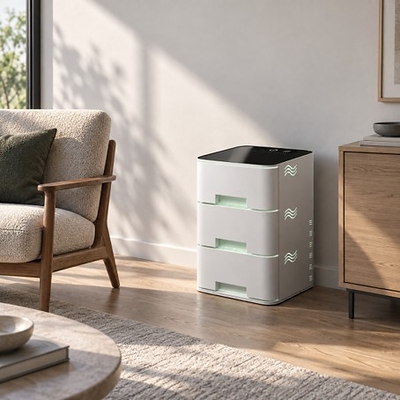
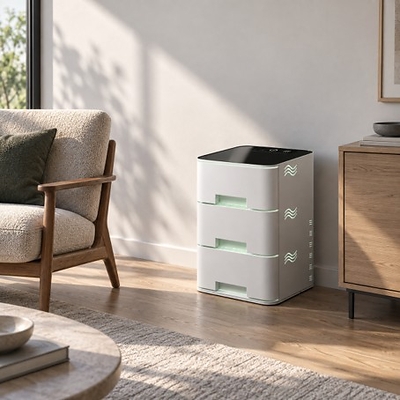
Closing windows to keep out smog can also trap exhaled carbon dioxide indoors, while limiting the flow of fresh air. greenwaterHOME uses microalgae to generate fresh oxygen and capture carbon dioxide, combined with a 3-stage filtration system similar to those used in traditional air purifiers.
GURUGRAM, India, Oct. 6, 2026 /PRNewswire/ -- The idea originated in California in 2022. An Indian undergraduate at the University of California San Diego began working on a question about the air inside closed rooms. The technology that came out of it had been recognised by a sitting U.S. Congressman, won the Grand Prize at UC San Diego's campus-wide environmental innovation competition, and was chosen as one of three startups to represent the university in Hong Kong.
Is an air purifier not enough?
"Every air device on the market only subtracts certain pollutants from the air. None of them add oxygen back," said Dhruv Mehta, Co-founder of Greenwater Scientific, "That gap is what we set out to work on."
In the following months, most homes in the metropolitan cities of India will keep their windows closed at all times to keep the pollution out. It's a reasonable response to the degrading air quality outside.
However, that also changes the air inside. A few people in a closed room constantly consume the limited amount of oxygen available around them and replace it with carbon dioxide. Occupants breathe it out continuously and, without ventilation, it has nowhere to go.
Air purifiers only use mechanical filtration that can capture dust particles but cannot alter the ratio of carbon dioxide to oxygen since they are molecular gases mixed into the air itself. For this, one needs a biological process like photosynthesis.
greenwaterHOME does both jobs. Its filters handle the smog; its microalgae absorb the carbon dioxide and release oxygen.
Are house plants not enough?
While indoor plants make the room look beautiful, they often do very little to nothing to help improve the air quality. The unnatural, overhead LED lighting does not allow photosynthesis.
Even if placed right next to a window, dust collection on the leaves prevents photons from interacting with the chlorophyll. Moreover, a lot of space is 'wasted' in the soil and stems as far as generating oxygen is concerned.
Microalgae, on the other hand, are far more efficient and effective at conducting photosynthesis (converting carbon dioxide into fresh oxygen). They also happen to be what make over 70% of our planet's oxygen.
Greenwater Scientific's device automatically creates the perfect environment for microalgae to grow in. Their technology controls the composition of nutrients, pH, temperature and movement that a culture of microalgae needs for ideal performance and health.
According to an independently tested NABL report, a single unit of greenwaterHOME produces as much oxygen as 64 snake plants.
The colour tells you it is working
Every other air device asks to be trusted. The filter is sealed inside a housing, and the only evidence of function is a number on a display or a grey cartridge pulled out six months later.
The Air Synthesizer is visible. The culture starts pale green and darkens as the algae multiply. Deeper green means more growth, which means more carbon dioxide consumed and more oxygen produced.
"You can watch it work," said Mehta. "Everyone already understands a plant getting greener means it's improving the air."
Recognition arrived before the category was widely understood.
The work developed across two countries. Research ran in California at UC San Diego, and through two cohorts at the Blackstone LaunchPad accelerator while engineering, testing and manufacturing were built out in India. A patent application was filed in 2023, and Greenwater Scientific was incorporated as a Private Limited company later the same year.
Over that period the company received a Certificate of Special Congressional Recognition from the U.S. House of Representatives, presented by Congressman Juan Vargas, citing 'efforts to create climate solutions that help to balance economic growth, energy needs and environmental goals.'
It won the Grand Prize at UC San Diego's Triton Innovation Challenge, the university's annual competition for environmental technology ventures. UC San Diego went on to nominate it as one of three startups representing the university at Techathon+, hosted by Hong Kong Science and Technology Park, one of Asia's largest innovation campuses.
It was selected for StartBlue, the ocean enterprise accelerator run by Scripps Institution of Oceanography with UC San Diego's Rady School of Management (a programme built around ocean science) and reached the finals of the Blackstone IDEAS Competition.
Both halves of the problem
Greenwater maintains that the distinction between an air synthesizer and an air purifier is functional rather than semantic. Purification describes removal. Synthesis describes production. greenwaterHOME does both.
For buyers this winter, the consequence is practical. A household comparing filtration performance across brands is comparing devices that all address the same half of the problem.
greenwaterHOME is available now at www.greenwaterscientific.com.
About Greenwater Scientific
Greenwater Scientific is an Indian biotechnology company developing microalgae technology for indoor air care. Co-founded by Sumir Mehta and Dhruv Mehta, the company combines research originating at the University of California San Diego with engineering and manufacturing in Manesar, Haryana. Its flagship product, the greenwaterHOME Air Synthesizer, uses living micro-algae to absorb carbon dioxide and release oxygen through photosynthesis, alongside three-stage filtration to remove airborne pollutants. Greenwater Scientific spent three years in the Blackstone LaunchPad Accelerator and received U.S. Congressional Recognition. For more information, visit www.greenwaterscientific.com
Media contact:[email protected] | greenwaterscientific.com

 View original content to download multimedia:https://www.prnewswire.com/in/news-releases/awarded-in-america-built-in-india-greenwater-scientifics-greenwaterhome-uses-algae-to-absorb-carbon-dioxide-and-produce-oxygen-in-sealed-rooms-302899608.html


