


Truth must remain journalism's guiding principle amid digital disruption: veteran journalist Raju Santhanam
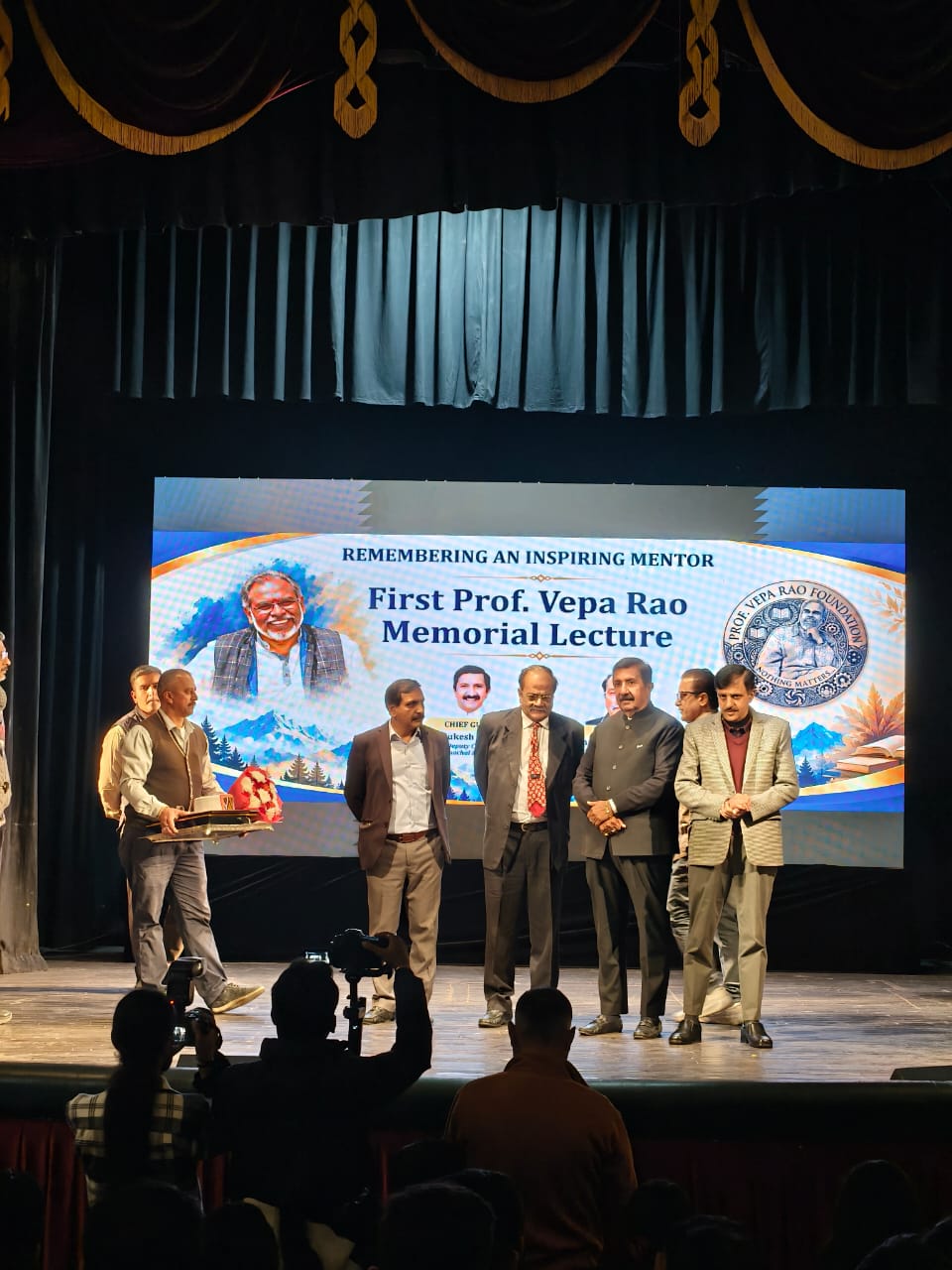
Shimla, Oct 31 (UNI) Journalism must adapt to changing technology and audience preferences without compromising factual accuracy, honesty and editorial independence, veteran journalist Raju Santhanam said on Saturday.
"Change the format. Improve the storytelling. Build the audience. But do not change the truth to win the click," Santhanam said while delivering the first Prof Vepa Rao Memorial Lecture here.
He said the rapid expansion of digital media, social media influencers, YouTube creators and artificial intelligence has intensified competition for audiences, making it essential for journalists to embrace new storytelling formats while upholding professional standards.
"Honesty, integrity and editorial independence must remain the guiding principles of journalism," he said, pointing to growing commercial pressures and the challenges posed by the rapidly changing media landscape.
Santhanam, who has more than three decades of experience across print, television and digital media, has served as editor of The Statesman and headed Zee News. He also shared a professional association with Prof Rao, having worked with him at The Statesman.
The lecture was organised jointly by Prof Rao's students, the Department of Journalism and Mass Communication at Himachal Pradesh University (HPU), and Keekli Trust to mark his fourth death anniversary.
Highlighting the growing blurring of boundaries between independent journalism and paid publicity, Santhanam recalled how advertorials and public relations material had gradually found their way into newspaper coverage.
The concern, he said, was not advertising or public relations as such, but the difficulty readers increasingly faced in distinguishing independent reporting from paid promotion.
Warning against sensational headlines and misleading presentation, he stressed that journalists must not allow the pursuit of readership or online clicks to distort facts.
An announcement of a scheme to generate 50,000 jobs, for instance, should not be presented as confirmation that those jobs have already been created. Similarly, an investigation into alleged wrongdoing should not be portrayed as an established case of corruption.
"Presenting allegations as established facts" amounted to a distortion of the truth, he said.
Referring to the Reuters Institute's 2026 news report, Santhanam noted the growing importance of online video and the convergence of traditional and digital media, with news stories increasingly moving between newspapers, television and YouTube.
He also cautioned that the Digital Personal Data Protection Act, in the absence of a clear exemption for journalistic activities, could hamper investigative reporting on matters of public interest.
Recalling instances of pressure faced by media organisations, Santhanam cited an investigation involving businessman Vijay Mallya during his tenure at The Statesman.
He said Mallya had arrived in Calcutta with a team of lawyers after the newspaper sent him a telex seeking his response to the investigation. The then editor-in-chief, C R Irani, stood firm, making it clear that Mallya was free to respond but could not dictate whether the report should be published.
He also recalled pressure during the newspaper's coverage of the Thakkar Commission, including discussions about disrupting the electricity supply to prevent publication. On another occasion, he was questioned over a test report that allegedly attracted provisions of the Official Secrets Act.
Attempts to identify confidential sources, he said, crossed a fundamental line, underlining that protecting sources remained essential to investigative journalism.
Recalling his tenure as editor of Zee News, Santhanam also spoke about pressure following the channel's telecast of the Tehelka tapes and a sting operation involving a Minister of State for Home Affairs. He said the management, led by Subhash Chandra, refused to buckle under pressure.
Editorial independence, he stressed, required not only journalists willing to stand their ground but also media managements prepared to withstand commercial and political pressure.
While acknowledging the importance of defamation laws and the protection of personal privacy, he said these considerations should not become obstacles to legitimate public-interest journalism.
Remembering Prof Vepa Rao, Santhanam said his contribution went far beyond his professional achievements. His commitment to mentoring young journalists, helping them secure professional opportunities and instilling values of honesty, integrity and sincerity had influenced generations of media professionals.
Himachal Pradesh Deputy Chief Minister Mukesh Agnihotri, who attended the programme as the chief guest, recalled his association with Prof Rao. Agnihotri, who worked as a journalist before entering politics, said Rao had encouraged him to look beyond Shimla and explore professional opportunities in Delhi.
Rakesh Kanwar, an IAS officer and former student of Rao, recalled that the professor turned everyday experiences into learning opportunities for his students.
"He made the entire world a classroom," Kanwar said, recalling how Rao would teach students even while crossing roads in Connaught Place or walking from The Ridge to the university.
His influence extended beyond professional guidance to the personal lives of his students, Kanwar said, adding that Rao had also helped many of them find life partners.
Others who spoke at the event included Shashikant Sharma, Head of the Department of Journalism and Mass Communication at HPU, Dinesh Sharma, formerly with Zee News, and Vijay Gupta, editor of Amar Ujala, Chandigarh.
UNI AAB


