


Rahul detained again as INDIA Bloc escalates EC battle, vows to continue protest until Gyanesh resigns
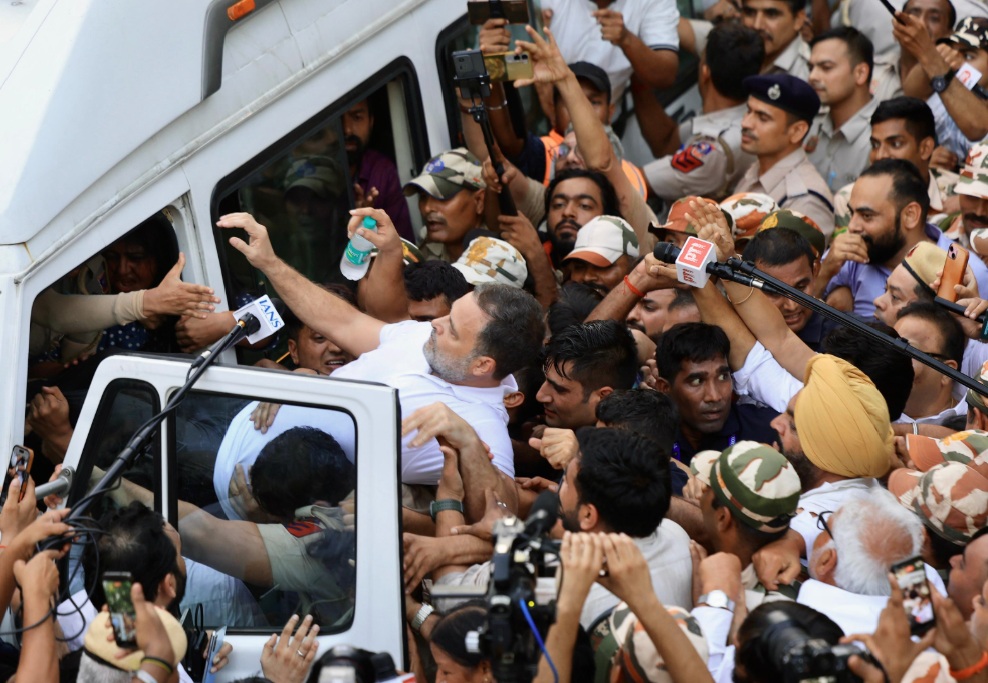
New Delhi, Oct 7 (UNI) Leader of the Opposition in the Lok Sabha Rahul Gandhi was detained by the Delhi Police on Wednesday as the INDIA bloc's confrontation with the Election Commission spilled into a second successive day of street protests, turning central Delhi into a battleground of barricades, slogans and political defiance.
Gandhi, Congress general secretary Priyanka Gandhi Vadra and several other Opposition MPs were detained while attempting to march towards Jantar Mantar to demand the resignation of Chief Election Commissioner Gyanesh Kumar over alleged irregularities in electoral rolls and the Special Intensive Revision (SIR) exercise. The dramatic confrontation followed a strategy lunch hosted by Congress president and Leader of the Opposition in the Rajya Sabha Mallikarjun Kharge, after which hundreds of INDIA bloc MPs and leaders sought to move towards the designated protest venue.
The march was halted by multiple layers of barricades and a heavy police deployment, triggering a prolonged standoff before the police moved in to disperse and detain the protesters. Gandhi was eventually taken away in a police bus, while visuals of the confrontation showed Opposition leaders resisting the attempt to clear the protest site. Gandhi, meanwhile, made clear that the Opposition had no intention of backing down.
"We are not going to stop protesting till Gyanesh Kumar resigns," he declared, framing the agitation as a battle over the constitutional right to vote rather than a routine political dispute. "This is a fight to protect the most sacred thing in this country," Gandhi said at the protest. The Opposition has sought to turn the SIR controversy into a larger political campaign over electoral integrity, alleging that genuine voters are being removed from electoral rolls and repeatedly using the phrase "vote chori" to describe what it calls systematic irregularities.
The Election Commission and the BJP-led government have rejected the allegations, maintaining that electoral-roll revision is a constitutional and statutory exercise intended to identify and remove duplicate, deceased and otherwise ineligible entries while ensuring that eligible voters remain on the rolls. Gandhi intensified his attack on Kumar during Wednesday's protest, insisting that the Opposition would continue to question the conduct of the poll panel and demand accountability from the Chief Election Commissioner.
Protesters raised slogans such as "Vote Chor, Vote Chor", "Gyanesh Kumar Hatao, Loktantra Bachao", "Gyanesh Kumar Resign" and "Tanashahi Nahi Chalegi", while placards carried the increasingly familiar message: "Gyanesh, It's Done Bro." The latest confrontation came barely 24 hours after an equally tense showdown in central Delhi. On Tuesday, Opposition MPs had marched from Parliament towards the Election Commission headquarters seeking a meeting with the poll panel and demanding Kumar's resignation.
The march was stopped near Akashvani Bhavan, following which Gandhi, Priyanka Gandhi Vadra and other leaders entered the premises and staged an extended sit-in after being denied passage towards the Election Commission. The standoff continued for roughly eight to nine hours before the protesters were detained. The confrontation has since acquired a legal dimension. Delhi Police registered an FIR against Gandhi, Priyanka Gandhi Vadra and others over their alleged entry into the Akashvani Bhavan premises without permission during Tuesday's protest.
Police said the case related to the alleged unauthorised entry after the Opposition march had been stopped. Gandhi responded to the FIR in characteristically defiant fashion, turning the police case itself into a political weapon. "I have 45 FIRs against me. My target is that there should be 100 FIRs against me. Every FIR against me is a medal for me," he told reporters, making it clear that the legal action would not deter him from continuing the campaign. The police action at Jantar Mantar produced another round of dramatic scenes as Opposition leaders resisted attempts to clear the protesters.
Priyanka Gandhi Vadra was seen confronting the police operation, while Gandhi also engaged with police officers as they moved to disperse the gathering. Opposition leaders alleged rough handling by the police, while the authorities proceeded to remove protesters and place them in buses. The escalating protests have transformed what began as an Opposition demand for answers on electoral-roll revision and a meeting with the Election Commission into a broader mobilisation around the slogans of protecting the vote and defending the Constitution.
The campaign has now stretched across Parliament Street, Akashvani Bhavan and Jantar Mantar, bringing the dispute over SIR directly into the streets of the national capital. For the Congress and its INDIA bloc allies, Gandhi's repeated detention and his decision to describe FIRs against him as "medals" have become part of a wider political narrative portraying the Election Commission as an institution that must answer questions about the integrity of the electoral process.
For the poll panel and the authorities, however, the issue remains one of following established procedures for electoral revision, maintaining public order and enforcing restrictions governing protests and access to designated or restricted premises. The competing narratives have ensured that the SIR controversy is no longer confined to electoral rolls. It has evolved into a larger political confrontation over the credibility of India's electoral system, the powers and accountability of the Election Commission and the Opposition's claim that the right to vote must be protected at all costs. As Gandhi was taken away in a police bus on Wednesday, the slogans continued to reverberate through central Delhi.
The Opposition's message remained uncompromising: the agitation would continue until its demand for Gyanesh Kumar's resignation was addressed. With the Congress and its INDIA bloc partners taking their battle from Parliament to the streets, the Election Commission has become the unlikely epicentre of one of the capital's sharpest political confrontations in recent months.
UNI SKA AAB


