


Pranab confidante feels Sonia memoirs unjust to his Guru
Jayanta Roy Chowdhury
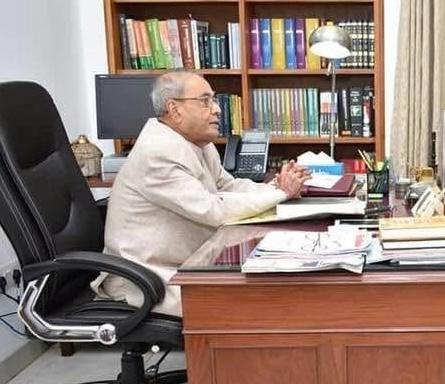
New Delhi, Nov 22 (UNI) Veteran Bengal politician Sukhendu Sekhar Roy, a former close associate and political confidante of Pranab Mukherjee and now a BJP Rajya Sabha MP, has accused the Congress leadership of repeatedly denying the former President his rightful place in Indian politics, arguing that he should have succeeded Indira Gandhi as Prime Minister after her assassination in 1984.
Roy, who describes Mukherjee as his "political guru", said the Congress' dynastic system prevented the veteran leader from becoming Prime Minister despite his experience, proximity to Indira Gandhi and standing within the party.
"By rights he ought to have been sworn in as Prime Minister after her assassination. But the dynastic system followed by the Congress party didn't allow him to be the successor," Roy said in an interview with UNI.
His remarks come against the backdrop of Sonia Gandhi's recently released memoir, Belonging: A Journey of Love, in which she recounts Mukherjee's suggestion in 2010 that there should be a "change at the top" of the UPA-II government, interpreting it as an indication of his long-held ambition to become Prime Minister.
Roy, however, said Mukherjee's suggestion was driven by concerns over the political fallout of mounting corruption allegations against the government, including the Commonwealth Games, Adarsh housing, coal block allocation and 2G spectrum controversies, which he feared could undermine the Congress's prospects in the 2014 elections too.
He said Mukherjee, who was overseeing several Groups of Ministers, believed a leadership change could help avert a repeat of the electoral setbacks suffered by the Congress in the 1990s following a series of earlier corruption allegations.
Roy also strongly disputed Sonia Gandhi's assertion in her memoir that Mukherjee left the Congress in 1984 after Rajiv Gandhi was chosen Prime Minister and subsequently formed his own party.
"On page 399 of her memoirs, Sonia Gandhi has written that Pranab left the party in 1984 and formed his own after Rajiv was chosen as Prime Minister. This is absolutely false," Roy claimed.
He said Mukherjee campaigned extensively for Congress candidates in the December 1984 Lok Sabha elections and was instrumental in recommending Mamata Banerjee as the party's candidate from Jadavpur, where she defeated CPI(M) leader Somnath Chatterjee.
Roy said Mukherjee was appointed president of the West Bengal Pradesh Congress in early 1985 and helped the party perform strongly in the Calcutta Corporation elections, falling just short of a majority by a single seat.
He alleged that Mukherjee was subsequently forced to resign as state Congress chief and was gradually sidelined from the party's central leadership before being expelled in April 1986 for alleged anti-party activities. Roy claimed the expulsion was effected without a show-cause notice.
Tracing Mukherjee's political trajectory, Roy said he played a pivotal role in the formation of Congress (I) after the party split in January 1978, when Indira Gandhi was unanimously elected its president. Mukherjee became treasurer, while Kamlapati Tripathi was appointed working president and several senior leaders were made general secretaries.
This, Roy said, helped Mukherjee consolidate his position within the organisation and deepen his political relationship with Indira Gandhi.
He also recalled Mukherjee's appearance before the Shah Commission, which investigated excesses during the Emergency. Roy said Mukherjee was among the few senior Congress leaders who refused to attribute their decisions during the Emergency solely to Indira Gandhi, instead maintaining that he had acted according to his conscience and would not breach the oath of secrecy taken as a minister.
Roy alleged that a group of Bengal Congress leaders, whom he described as a "Gang of Four", propagated the claim that Mukherjee was seeking the Prime Minister's post after Indira Gandhi's assassination, a narrative he said was subsequently reinforced by leaders close to Rajiv Gandhi and contributed to Mukherjee's exclusion from the new government.
He also claimed that Mukherjee's exclusion from the Cabinet when P V Narasimha Rao became Prime Minister in 1991 was influenced by external pressure, although he did not provide evidence for the allegation.
Mukherjee was later appointed deputy chairman of the Planning Commission and went on to serve as Commerce and External Affairs Minister, by Prime Minister Rao known to be his political ally within the party.
Highlighting Mukherjee's role in India's economic diplomacy, Roy credited him with negotiating India's entry into the World Trade Organisation and helping integrate the country into the global trading system through the General Agreement on Tariffs and Trade (GATT).
He said Mukherjee had faced a sustained political campaign over the trade negotiations, particularly in West Bengal, where Leftist critics also portrayed him as responsible for the Centre's alleged neglect of the state.
Roy also recalled Mukherjee's role in securing the India-US civil nuclear agreement during the UPA government, saying he was instrumental in navigating the negotiations despite threats by Left parties to withdraw support.
Mukherjee, Roy said, was again overlooked for the Prime Minister's post in 2004 and 2009 despite his seniority and extensive experience in government.
"Pranab Da was deprived of the PM position because he was neither a Gandhi nor had any other mentor," Roy said.
Reflecting on his four decades in the Congress, Roy said he had been closely associated with several national and state leaders but regarded Mukherjee as his political mentor.
He recalled that after Mukherjee became President in 2012, several Congress leaders, MPs and ministers had told him they would have preferred Mukherjee as Prime Minister and Manmohan Singh as President.
UNI JRC RSA


