


PM Modi unveils Rs 13,000-crore TN development package: Puts Metro expansion, industrial growth in focus
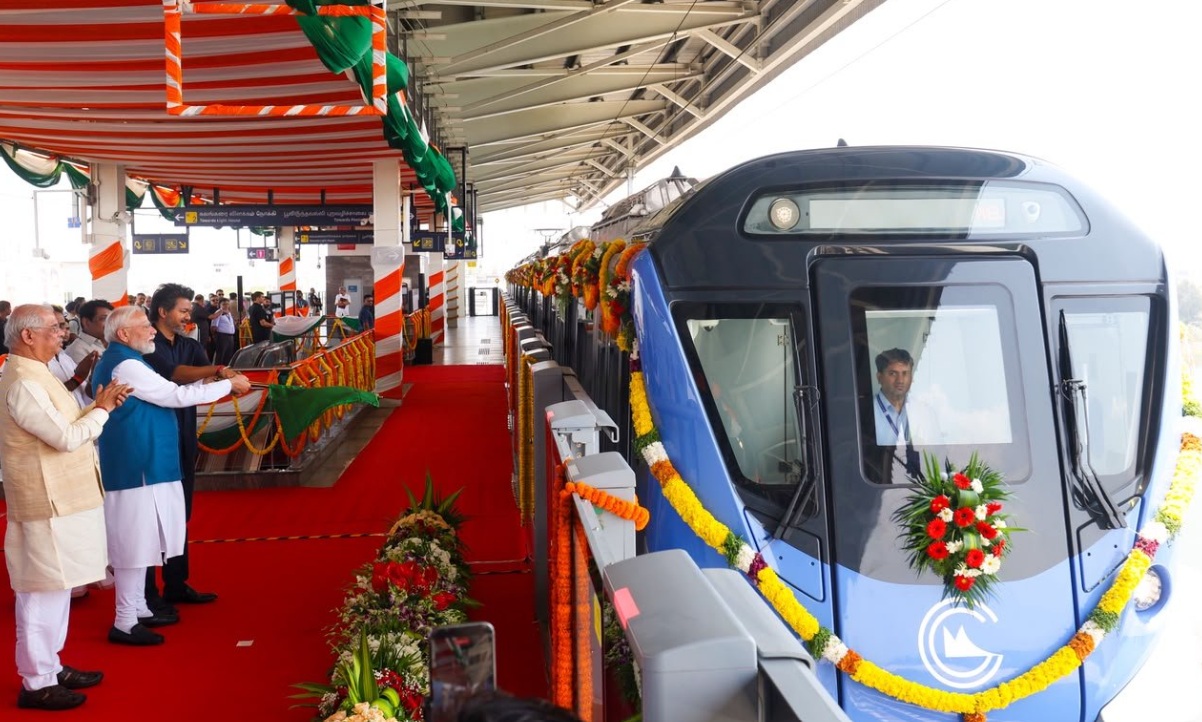
New Delhi, Oct 11 (UNI) Prime Minister Narendra Modi on Sunday unveiled a development package worth more than Rs 13,000 crore in Chennai, inaugurating completed projects, dedicating infrastructure to the nation and laying foundation stones for new initiatives across metro rail, highways, railways, ports, petroleum and education, while emphasising industrial growth, employment generation and cooperation between the Centre and Tamil Nadu.
Addressing a gathering at the Indian Institute of Technology Madras in the presence of Tamil Nadu Governor Rajendra Arlekar and Chief Minister C Joseph Vijay, Modi described the projects as a significant milestone in the state's development, saying they would improve urban mobility, strengthen industrial and freight connectivity, expand trade infrastructure and create opportunities for young people. "This is a historic day for Tamil Nadu," the Prime Minister said. "Today's programme involves projects worth Rs 13,000 crore. We are inaugurating many completed projects and laying foundations for new ones. Some will make daily travel easier. Others will strengthen industry and trade. Together, they will create jobs for young people across Tamil Nadu."
Seeking to underline the political and administrative continuity of his development agenda, Modi said his approach had consistently rested on the principles of democracy, the participation of people and cooperative federalism. Recalling that he had taken oath as Gujarat Chief Minister in October 2001 before becoming Prime Minister in 2014, he said completing 25 years in government leadership earlier this month had reinforced his belief that the country's progress depended on the development of its states. "I have always followed the principle that the development of the country must begin with the development of its states," he said, adding that his experience as a chief minister had helped him understand the aspirations and challenges of state governments. He said the union government had subsequently sought to support states in pursuing their own development priorities.
Referring to his interactions with former Tamil Nadu chief ministers M Karunanidhi, J Jayalalithaa, O Panneerselvam and Edappadi K Palaniswami, as well as former chief minister M K Stalin, Modi said political administrations had changed over the years, but his commitment to Tamil Nadu's development and the welfare of its people had remained unchanged. "Today, with the same commitment, we are taking forward Tamil Nadu's development journey together with Chief Minister Joseph Vijay," he said. The emphasis on cooperation came as Modi presented the investments as part of a wider strategy to strengthen Tamil Nadu's manufacturing base, modernise transport networks and improve its competitiveness in domestic and international markets. He called for the Centre and the state government to work together towards the goal of a developed Tamil Nadu contributing to a developed India.
The inauguration of the Poonamallee-Vadapalani stretch of Chennai Metro Rail's Phase II was among the major highlights of the programme. The expansion is intended to improve connectivity across western Chennai, ease commuting pressures and offer residents, students, working families and senior citizens a more convenient alternative to road travel. The corridor incorporates a distinctive double-decker structure combining road and metro infrastructure, along with modern signalling technology designed to support driverless train operations.
Following the inauguration, Modi and Vijay travelled by metro from Porur Bypass station to Poonamallee Bypass station. During the journey, the Prime Minister interacted with young start-up entrepreneurs, highlighting the importance of innovation, entrepreneurship and technological advancement in India's economic future. Modi said urbanisation should be viewed as an opportunity rather than a challenge, arguing that cities needed comprehensive infrastructure and efficient public transport instead of relying exclusively on road expansion.
Better mass transit, he said, was essential to improving the quality of urban life and making rapidly growing cities more accessible. Citing the expansion of India's metro network, Modi said services had grown from five cities in 2014 to 25 cities, while the total network had increased from approximately 250 kilometres to more than 1,100 kilometres. The Chennai expansion, he said, would further strengthen the country's urban transport infrastructure. For Chennai, the benefits of metro expansion extend beyond the introduction of services on an individual corridor. The city's growing residential suburbs and employment centres require reliable connections that can reduce dependence on private vehicles, ease congestion and improve access to workplaces, educational institutions and commercial districts. Effective integration with buses, suburban rail, last-mile transport and pedestrian facilities will remain important in ensuring that the new infrastructure delivers its full potential.
Highway and railway investments formed another major component of the package. Highway works valued at approximately Rs 3,700 crore are intended to improve connectivity and facilitate the movement of passengers and freight. Among the projects highlighted was the inauguration of the 36-kilometre, four-laned Vadugapatti-Therkuvenganallur section of National Highway 744. Modi stressed that roads, railways and ports were critical to manufacturing growth because industrial competitiveness depended on the reliable and timely movement of raw materials, components and finished products. Better connectivity, he said, could reduce logistical bottlenecks, improve access to markets and strengthen the ability of businesses to expand their operations. He also highlighted the employment potential of infrastructure investment, noting that construction generates demand for engineers, technicians, skilled workers and labourers while supporting industries supplying cement, steel, machinery and other materials.
Once operational, the projects could help manufacturing and service enterprises expand by reducing transport costs and improving the movement of goods. Linking the investments to the union government's Make in India and Vocal for Local initiatives, Modi praised Tamil Nadu's contribution to India's industrial development. He said the objective was to strengthen the entire manufacturing chain, from components and technology to finished products, rather than focus on isolated stages of production. Citing the growth of India's electronics and engineering sectors, the Prime Minister said India had become the world's second-largest mobile-phone manufacturer.
He claimed that electronics exports had increased 11-fold since 2014, defence exports had risen 50-fold and engineering exports had reached a record level. He attributed the expansion of manufacturing to the creation of millions of direct and indirect employment opportunities, acknowledging the contribution of Tamil Nadu's workforce and industrial enterprises. The foundation stone for a new advanced lubricant base oil project was also laid as part of the industrial development initiatives. Modi said the project would generate employment and help reduce India's dependence on imports. The investment reflects the broader effort to expand domestic production of industrial materials and strengthen the country's manufacturing capabilities. Port infrastructure featured prominently in the Prime Minister's address, with particular attention to V O Chidambaranar Port in Thoothukudi. Modi referred to the union government's plan to invest approximately Rs 17,000 crore in developing the port into a world-class mega container and green energy hub.
The proposed expansion is intended to accommodate ultra-large container vessels and strengthen Tamil Nadu's position in international shipping, logistics and industrial trade. Modi said improvements in the speed and efficiency of Indian ports had reduced vessel turnaround times by about half, helping Indian products reach global markets more quickly. He argued that port modernisation was indispensable to building a competitive manufacturing economy, as delays in shipping and freight movement can increase business costs and undermine export competitiveness.
The Prime Minister also highlighted the potential of the ocean economy and the importance of protecting the livelihoods of fishing communities along Tamil Nadu's extensive coastline. He said the union government had approved projects worth thousands of crores of rupees for the state under the Pradhan Mantri Matsya Sampada Yojana and other programmes. These initiatives include the modernisation of fishing harbours and landing centres, improvements to cold-chain facilities and support for vehicles used to transport fish while maintaining freshness. Modi referred to the modernisation of Chennai Fishing Harbour and the development of a seaweed park in Tamil Nadu as initiatives aimed at expanding economic opportunities in the fisheries sector. He said fishermen were also being given easier access to working capital through the Kisan Credit Card scheme.
According to the Prime Minister, India's fish production had increased and seafood exports had reached their highest levels in both quantity and value during the previous year. He said these developments were helping improve incomes and livelihoods among fishing families and coastal communities. Scientific research and innovation formed another strand of the visit. Modi visited the brain research centre at IIT Madras, where he highlighted the potential of advanced research to create new opportunities in public health and address pressing social challenges.
The engagement underscored the relationship between scientific progress, technological innovation and economic development. At the golden jubilee celebrations of Jaigopal Garodia Hindu Vidyalaya Matriculation Higher Secondary School, the Prime Minister turned his attention to the role of young people in shaping India's future. He said the country's ambitions required fresh ideas, innovative thinking and solutions capable of influencing not only India's development but also the wider world. "Today, India's youth want to become the strength of the vision of a developed India," Modi said. Urging young people to recognise the opportunities before them, he added: "I want every young person to see their future on that larger canvas. Because this is your time. This is your opportunity." The Prime Minister began his address by extending Navratri greetings to the people of the country. Referring to Tamil Nadu's spiritual and cultural traditions, he said he had received the blessings of Lord Shiva at the Jaldeekateswarar Temple before attending the programme. He also paid tribute to Jayaprakash Narayan and Nanaji Deshmukh on their birth anniversaries, describing their lives as a continuing source of inspiration for national service.
Bringing together the themes of cultural heritage, scientific progress and modern infrastructure, Modi argued that India's traditions and future ambitions complemented each other. "India draws inspiration from its cultural strength, advances through scientific progress and creates new opportunities through modern infrastructure," he said. "Our heritage and our aspirations for the future are moving forward together." The Chennai programme comes amid sustained investment in urban transport, highways, railways, industrial facilities and port infrastructure across the country.
For Tamil Nadu, one of India's major manufacturing and export-oriented states, the success of the investments will depend not only on the scale of announced expenditure but also on timely execution, efficient operation and coordination between different transport systems. Reiterating the Centre's commitment to Tamil Nadu's development, Modi called for cooperation between the state and union governments to advance the vision of a developed Tamil Nadu as part of a developed India.
UNI SKA RSA


