


Pawan Khera defends Opposition's right to seek change of Govt, Says BJP cannot claim ownership of Constitution
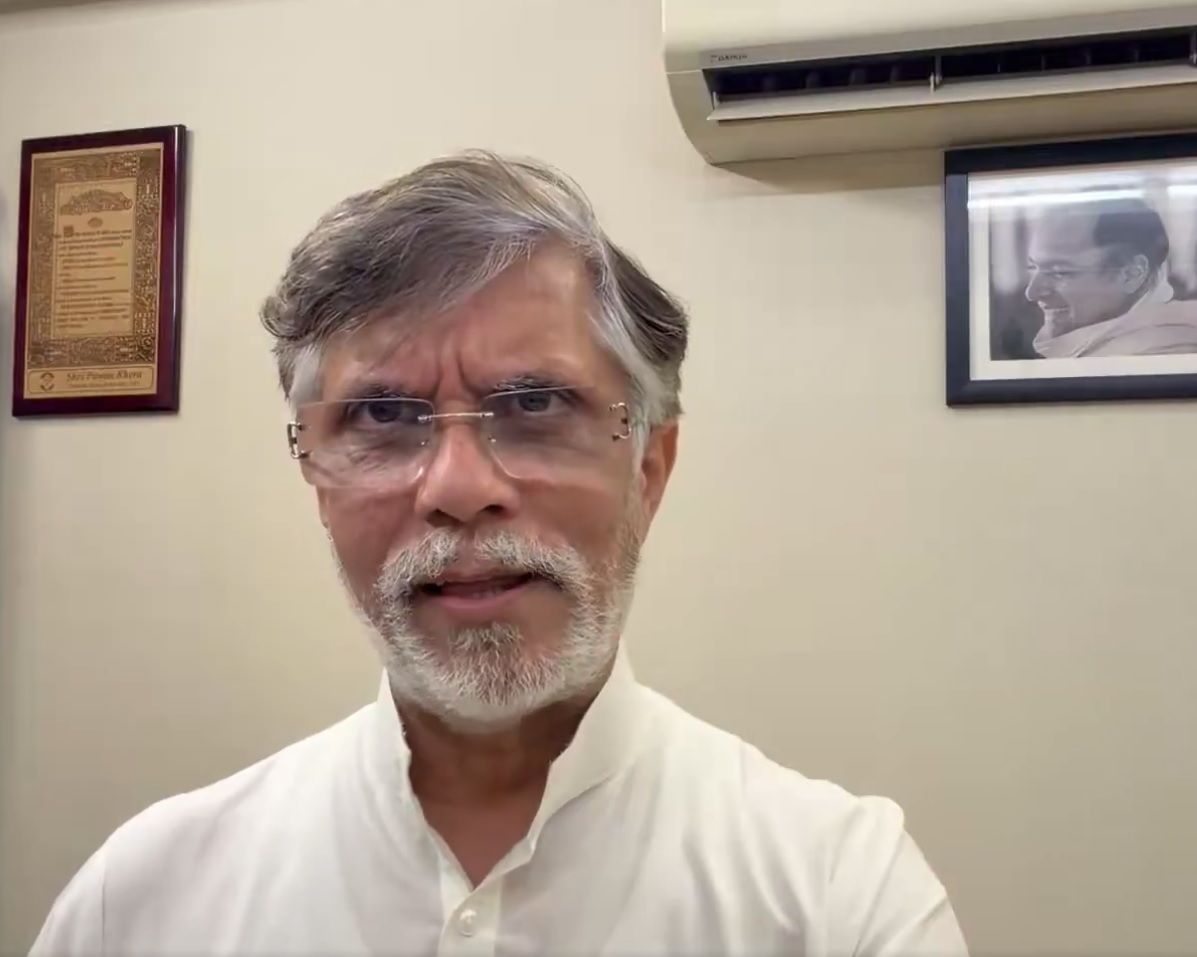
New Delhi, Oct 16 (UNI) Congress chairman of Media and Publicity Pawan Khera on Friday defended the Opposition's demand for a change of government through democratic means, accusing the BJP of conflating its government with the Indian Republic and warning that attempts to portray peaceful protests as a conspiracy for "regime change" undermined the principles of parliamentary democracy.
Addressing a press conference, Khera said ministers in the Narendra Modi government needed to recognise that they held office for a fixed five-year term granted by the people and could not claim ownership of the country or its Constitution. "The BJP is not the Constitution. Demanding a change of government through democratic means is neither sedition nor treason," he said. Citing India's political history, Khera pointed to the changes of government in 1977, 1980, 1989, 2004 and 2014, arguing that successive transfers of power had taken place through peaceful and constitutional means. From the formation of the first non-Congress government under Morarji Desai to Narendra Modi becoming Prime Minister in 2014, he said, governments had changed through the electorate's verdict rather than a coup.
"Was the BJP's own ascent to power in 2014 also a conspiracy for regime change?" he asked. Invoking former President and Bharat Ratna awardee Pranab Mukherjee, Khera recalled his observation that "it is the opposition's duty to oppose, expose and, if possible, depose". He also referred to former BJP leaders Arun Jaitley, Sushma Swaraj and L.K. Advani, arguing that they had defended mass agitations and street protests when their party was in Opposition. He questioned whether the meaning of democracy had changed since Modi became Prime Minister, recalling the latter's assertion that "criticism is the soul of democracy".
Defending the Congress and the INDIA bloc's recent protests over alleged electoral irregularities and the deletion of voters' names during the Special Intensive Revision (SIR) of electoral rolls, Khera said the Opposition had pursued its demands through constitutional channels rather than attempting to undermine democratic institutions. He referred to the October 12 march to the Supreme Court by Leader of the Opposition in the Lok Sabha Rahul Gandhi, Congress president Mallikarjun Kharge, INDIA bloc leaders and citizens seeking judicial intervention over the alleged irregularities.
Khera said the Supreme Court had issued notice to the Election Commission on October 15 on the Opposition's petition, underscoring the importance of institutional scrutiny and accountability. Khera also argued that recent decisions by the Election Commission demonstrated the importance of sustained democratic pressure. Following repeated demands by Rahul Gandhi for transparent, accessible and machine-readable electoral rolls, the Commission had directed that recognised political parties be provided with searchable digital rolls and details of additions, deletions and modifications. It had also announced an annual Special Summary Revision across 17 States and union Territories to facilitate the enrolment of eligible voters, including those who might have been left out during the SIR exercise.
While acknowledging that these measures fell short of the Congress's demands, Khera maintained that they illustrated why democratic scrutiny was indispensable. He said the party's demand for the resignation of Chief Election Commissioner Gyanesh Kumar was intended to establish accountability and restore public confidence in the electoral process, not to attack the Election Commission as an institution.
To challenge what he described as the BJP's selective interpretation of democratic protest, Khera invoked the political history of its ideological predecessors. He recalled that Atal Bihari Vajpayee, addressing the Bharatiya Jana Sangh's Hyderabad conference in September 1974, had argued that political struggle could not be confined to Parliament and had to extend to the streets and centres of power. Khera also cited the nationwide railway strike of 1973-74 led by George Fernandes, who later became Defence Minister in the Vajpayee government, and the Jana Sangh's participation in the movement led by Jayaprakash Narayan. Narayan had appealed to police and armed forces personnel not to obey orders they considered illegal or unconstitutional. Khera questioned why political mobilisation defended by the BJP's predecessors was now being portrayed as a conspiracy when undertaken by the Opposition.
Turning to the debate over constitutional amendments, Khera accused the BJP and the Rashtriya Swayamsevak Sangh of having a history of questioning aspects of the existing constitutional framework. He referred to statements made during the 2024 Lok Sabha elections by BJP leaders Anantkumar Hegde, Lallu Singh and Jyoti Mirdha concerning constitutional amendments and the parliamentary majority required to undertake them. He also cited the RSS' objections to the inclusion of the words "secular" and "socialist" in the Constitution's Preamble.
Khera argued that the BJP's "Congress-Mukt Bharat" slogan, alongside its "Ab Ki Baar, 400 Paar" campaign during the 2024 general election, raised questions about its approach to political pluralism and the role of a strong Opposition. He maintained that democratic competition, peaceful mobilisation and demands for electoral reform were essential features of parliamentary government. The Congress, he said, categorically rejected any unconstitutional seizure of power and remained committed to peaceful democratic mobilisation, constitutional institutions, free and fair elections and the sovereign will of the people. "Questioning an Election Commissioner is not an assault on the Election Commission. Demanding electoral reforms is not an attack on democracy. Seeking the democratic replacement of a government is not a coup," Khera said.
Asserting that no government could claim immunity from scrutiny and no political party could treat the Constitution as its own, Khera said governments might come and go, but the Constitution endured and the people alone remained sovereign. "India is not a one-party State. No Prime Minister enjoys a permanent mandate. No government is above scrutiny, and no political party can claim ownership of the Constitution," he said.
UNI SKA RN


