


Kharge accuses Modi Govt of favouring corporate giants, says monopolies are killing competition
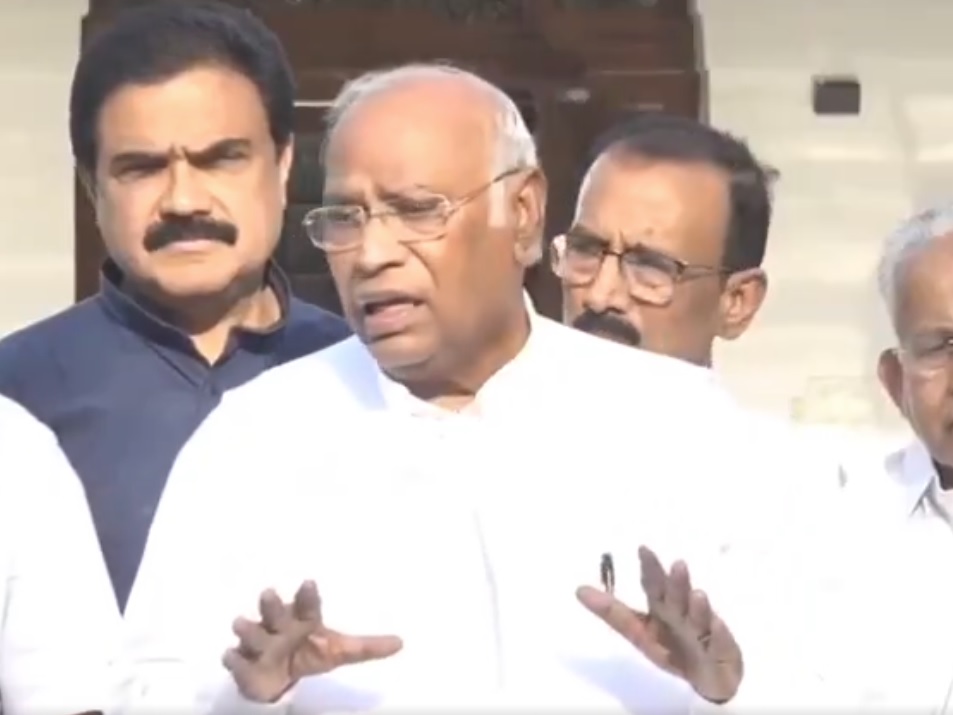
New Delhi, Oct 9 (UNI) Congress president and Leader of the Opposition in the Rajya Sabha Mallikarjun Kharge on Friday accused the Narendra Modi government of undermining the foundations of economic liberalisation by allegedly concentrating economic power in the hands of a few favoured corporate groups, claiming that the resulting monopolies and duopolies were hurting small businesses, weakening competition and aggravating the employment crisis facing the country's youth.
In a post on the social media platform X, Kharge alleged that the government's economic policies were designed to hand control of the Indian economy to industrialists close to the ruling Bharatiya Janata Party (BJP), with the party allegedly benefiting from the concentration of corporate profits.
"The objective of Modi ji's economic policy is to hand over control of the economy to his favoured capitalist friends, so that the BJP can secure a share of their profits in return," Kharge said. Accusing the government of encouraging monopolies and duopolies at the expense of a competitive market, the Congress president alleged that its policies had served to fill the BJP's coffers while dismantling the foundations of economic liberalisation. "By eliminating competition and establishing monopolies and duopolies, they have worked only to fill the BJP's coffers and destroy the foundations of economic liberalisation," he said.
To buttress his allegations, Kharge cited developments in the telecom and domestic aviation sectors since 2014, arguing that the number of significant players had declined sharply. He claimed that the telecom sector, which had 13 players before 2014, now had only three major private players. In domestic aviation, he said, the number of significant players had fallen from seven to just two. Kharge also flagged what he described as weakening competition in other sectors, including digital payments, cement and food-delivery applications, contending that growing market concentration raised serious questions about the ability of smaller businesses to compete with dominant companies.
Seeking to contrast the Congress's economic legacy with the BJP's record in government, Kharge asserted that his party had laid the foundations of economic liberalisation in India, while accusing the Modi government of prioritising corporate interests over broader economic development.
"The Congress party is the mother of economic liberalisation," he said, accusing the BJP of pursuing what he described as "economic terrorism" for its own financial benefit. The Congress president alleged that the consequences of the government's policies were particularly damaging for micro, small and medium enterprises (MSMEs) and other small and medium-sized industries, claiming that many businesses had been forced to shut down.
He further argued that the country's youth were bearing the brunt of a deepening employment crisis. The allegations form part of the Congress's wider political offensive against the Modi government's economic record, with the opposition party repeatedly raising concerns over economic inequality, the concentration of corporate wealth, the condition of small businesses and inadequate employment opportunities.
The Congress maintains that economic growth must be accompanied by wider market competition, stronger support for smaller enterprises, and the creation of sustainable jobs. Economic liberalisation in India is principally associated with the landmark reforms introduced in 1991 under the Congress government led by Prime Minister P V Narasimha Rao, with Manmohan Singh serving as finance minister. The reforms dismantled several licensing and regulatory restrictions, opened up sectors to greater private participation, and expanded the role of market forces in the economy.
Kharge's latest intervention seeks to draw a distinction between liberalisation intended to promote competition and what the Congress alleges is the concentration of economic power among a limited number of large corporate groups. The party argues that market dominance by a handful of companies can undermine opportunities for smaller enterprises, restrict competition, and leave the wider economy vulnerable to the decisions of a few powerful players. By linking corporate concentration with the struggles of MSMEs and the shortage of jobs, the Congress president has sought to frame the issue as one extending beyond economic policy to questions of livelihood, opportunity, and the distribution of the benefits of growth. The BJP and the government's position on the specific allegations were not included in Kharge's post as described.
UNI SKA RSA


