


India's angry autumn of discontent and the jobs numbers
Jayanta Roy Chowdhury
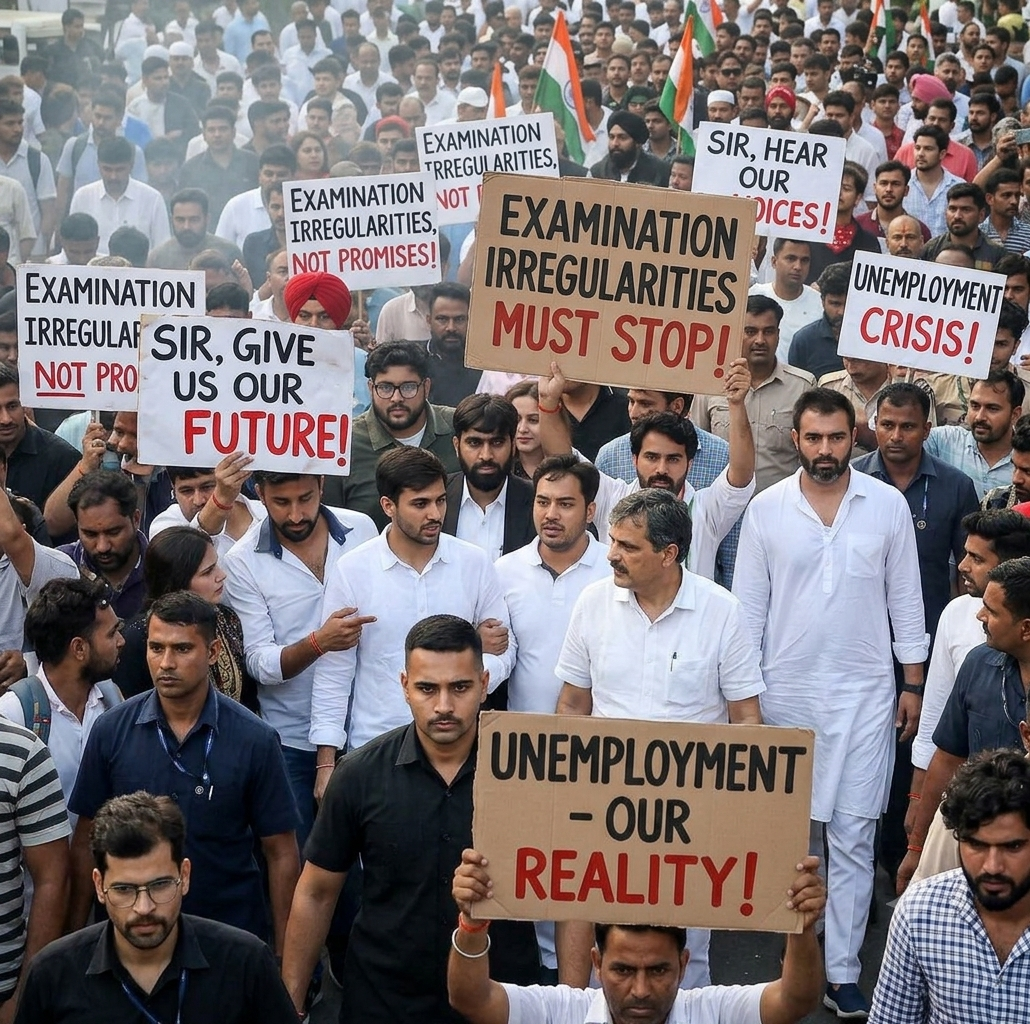
New Delhi, Oct 14 (UNI) Pictures and videos of India's youth out on the streets marching towards the Parliament or towards the Supreme Court have taken over much of the country's social media.
First came protests over alleged examination irregularities, now anger has turned to the revision of electoral rolls. The immediate grievances differ, but the underlying frustration has perhaps little to do with what is being protested against. The real root cause of India's angry young generation perhaps stems from the struggle to find a decent job in an economy that promises much but is seen to deliver far less to those in the job market.
"Since the Covid, all over the world, corporates have been busy trying to shore up profitability by reducing headcount. This has created an existentialist crisis for the youth, increasing their sense of anxiety with the system as it exists … the protests on India's streets as elsewhere in the world are a pointer to that," said Prof Biswajit Dhar, former President of the prestigious Delhi-based Council for Social Development.
India has been there before - in the 1960s and 1970s, student unrest reflected unemployment, linguistic tensions and wider political discontent; later in 1990, anger over reservations in education and public employment brought the country to a halt as young people came out into the streets. Beneath the surface of demands, the real cause was the same - a growing mismatch between aspiration and opportunity in the job market.
"The figures are stark. Unemployment, especially among the educated, is rising at a fast pace," said Dhar, who has previously taught at the Centre for Economic Studies and Planning (CESP), Jawaharlal Nehru University (JNU). In 2026, young Indians are better educated, more connected, and more ambitious than ever before. Yet qualifications increasingly fail to guarantee the economic security that previous generations found more easily. Official claims of robust growth, India's economy has expanded at about 7 per cent annually, sit uneasily alongside a labour market struggling to absorb its young.
In June, unemployment among people aged 15-29 actively seeking work reached 16.2 per cent, according to the Periodic Labour Force Survey, up from a previously alarming rate of 13.8 per cent reported in April 2025. The unemployment rate for urban areas, where most of the protests have been concentrated, was far higher at 18.2 per cent, compared to 15.1 per cent in rural areas. For young women, many of whom are seen as leaders of the student and youth movements that are still on, the unemployment rate stands at an astounding 20.7 per cent. The country has about 367 million young men and women in the age group of 15-29, with millions more entering the workforce each year. Estimates cited in recent analyses suggest that nearly 40 per cent of graduates aged 15-25 are unemployed, as are about a fifth of those aged 25-29. A degree, once a reliable route to middle-class security, is losing its purchasing power as robotisation is killing jobs on the shop floor while artificial intelligence is killing entry-level service sector jobs.
Out migration of the "bright and beautiful" is in the doldrums as Europe and North America tighten border control and shut the door to high paying jobs to non-locals. Another major problem for the current generation is the huge mismatch between what is learnt in classrooms and what workplaces demand. Employers complain of inadequate practical skills, while vocational training, apprenticeships and structured workplace learning remain limited.
The government think tank NITI Aayog has noted that only 8 per cent of secondary and higher-secondary schools offered courses aligned with the National Skills Qualifications Framework, according to one assessment. However, skills alone cannot solve the problem of jobless growth that India seems to be going through. Training more employable graduates will achieve little if the economy does not create enough jobs to absorb them. India needs both a workforce equipped for modern industry and businesses willing and able to hire that workforce. However, every protest be reduced to a function of the employment statistic. Electoral integrity, social justice and political representation matter in their own right. Nevertheless, joblessness and underemployment can turn disparate grievances into a broader rejection of the status quo. Social media accelerates that process, making both domestic inequalities and global comparisons impossible to ignore.
The danger for the government is therefore larger than a succession of street protests. Prolonged disappointment can undermine faith in education, institutions and the promise of economic progress itself.
UNI JRC RSA


