


INDIA bloc takes "vote chori" battle to Supreme Court, Rahul leads defiant march against CEC
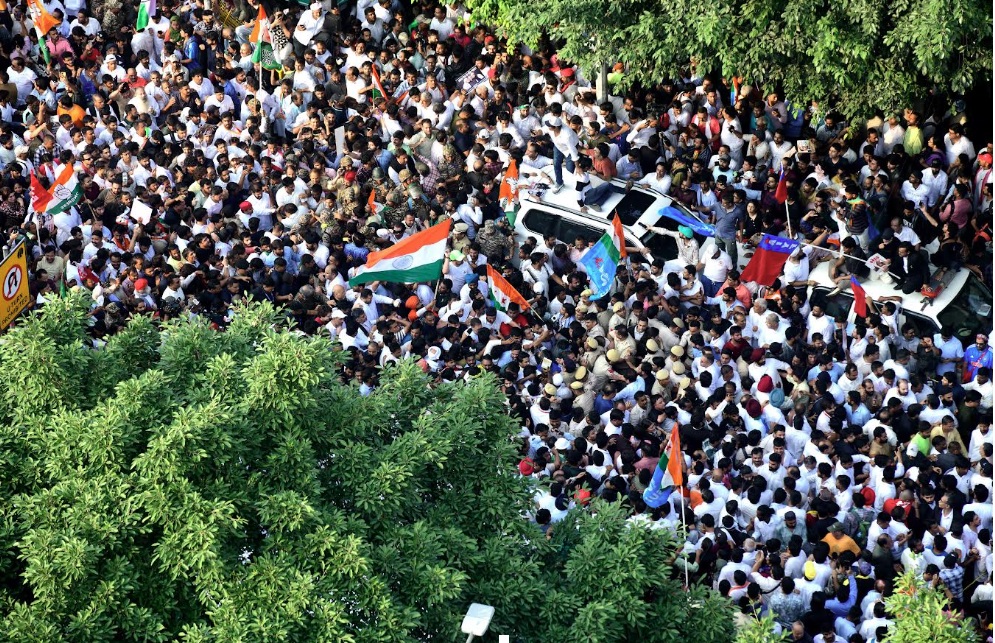
New Delhi, Oct 12 (UNI) In a fresh escalation of the Opposition's confrontation with the Election Commission of India (ECI), the INDIA bloc on Monday marched towards the Supreme Court, with Leader of the Opposition in the Lok Sabha Rahul Gandhi leading a show of defiance through the heavily barricaded streets of central Delhi and reiterating demands for the resignation of Chief Election Commissioner Gyanesh Kumar, suspension of the Special Intensive Revision (SIR) of electoral rolls and a return to ballot papers in place of electronic voting machines (EVMs).
The march, which began at the Constitution Club of India and proceeded along Barakhamba Road towards Bhagwan Das Road and the Supreme Court, brought together prominent Opposition leaders, MPs and party cadres in an attempt to transform their allegations of "vote chori" into a wider campaign for electoral accountability.
The mobilisation unfolded amid an imposing security deployment, with Delhi Police, the Central Reserve Police Force and the Rapid Action Force manning barricades at strategic points to prevent the protesters from advancing. Congress president Mallikarjun Kharge, Rashtriya Janata Dal leader Tejashwi Yadav, Trinamool Congress MPs Mahua Moitra and Sagarika Ghose, Shiv Sena (UBT) MP Sanjay Raut, Nationalist Congress Party (Sharadchandra Pawar) leader Supriya Sule and Samajwadi Party MP Dharmendra Yadav were among the prominent leaders who joined Rahul Gandhi. Members and cadres associated with Left youth organisations, the Indian Youth Congress and the National Students' union of India also participated.
The Aam Aadmi Party and the Dravida Munnetra Kazhagam, however, were conspicuous by their absence. The streets around Mandi House, Bengali Market and Bhagwan Das Road were transformed into a security zone, with multiple layers of barricades, police personnel and detention vehicles deployed to contain the procession. Authorities imposed prohibitory restrictions under Section 163 of the Bharatiya Nagarik Suraksha Sanhita, while six Metro stations in Lutyens' Delhi were closed until 4 pm, disrupting public transport and inconveniencing commuters. Traffic diversions further complicated movement across the capital's central districts.
The march followed an unsuccessful attempt by Opposition leaders to secure a personal meeting with Chief Justice of India Surya Kant to submit a memorandum outlining their concerns over the electoral process. The Chief Justice declined the request for a direct meeting, indicating that grievances concerning elections and the Election Commission must be pursued through established judicial procedures, particularly when related issues are already under consideration before the courts.
The refusal to entertain a direct representation did not deter the Opposition from pursuing its campaign. Instead, the INDIA bloc decided to take the legal route, with a designated delegation of 10 Opposition leaders announcing plans to file a writ petition in the Supreme Court. The move marks a shift from seeking an informal audience with the Chief Justice to pursuing judicial relief through the court's established adjudicatory process. At the heart of the agitation are allegations of "vote chori" and fears that the SIR exercise could lead to the arbitrary deletion of eligible voters from electoral rolls.
Opposition parties contend that the revision process must be transparent, backed by adequate safeguards and accompanied by an accessible mechanism through which citizens can challenge the removal of their names. They have also questioned the Election Commission's handling of electoral reforms, arguing that the credibility of the electoral process depends on public confidence in the institution responsible for conducting elections.
The demand for Gyanesh Kumar's resignation has become a central plank of the Opposition's campaign, with leaders accusing the poll panel of failing to address their concerns adequately. The Election Commission and the government have defended the existing electoral framework, while the Opposition's allegations remain contested and are now set to be tested through the legal process. The dispute has increasingly expanded beyond the mechanics of voter-list revision to raise wider questions about the independence of constitutional institutions, the integrity of elections and the protection available to citizens whose names may be removed from electoral rolls.
For the Opposition, the SIR controversy is not merely an administrative disagreement but a test of whether every eligible citizen can exercise the constitutional right to vote without fear of arbitrary exclusion. The demand to discontinue EVMs and restore ballot papers has added another contentious dimension to the confrontation.
Opposition parties argue that a return to paper ballots would help restore confidence in the electoral system, while the Election Commission has defended the existing framework. The disagreement has left the two sides locked in an increasingly bitter political and institutional dispute.
By taking their agitation towards the Supreme Court, the INDIA bloc sought to signal that its campaign would not remain confined to parliamentary debates, press conferences and political rallies. The decision to pursue a writ petition also places the controversy within a formal judicial framework, where the Opposition will have to substantiate its allegations and establish the legal grounds for the relief it seeks. The immediate outcome will depend on the petition filed by the Opposition delegation and the Supreme Court's response.
The march itself, however, demonstrated the bloc's determination to sustain pressure on the Election Commission through both street mobilisation and legal action. The confrontation also highlighted the wider public consequences of the escalating stand-off, as security restrictions, Metro closures and traffic diversions disrupted daily life in the capital. With the Opposition determined to continue its campaign against the poll panel while pursuing judicial remedies, electoral integrity and the future of the SIR exercise are set to remain major flashpoints in the political battle between the ruling establishment and its challengers.
UNI SKA BM


