


Europe convulsed by wave of protests as France braces for a second month of unrest
Arti Bali
New Delhi, Oct 25 (UNI) France has been gripped by one of its most serious waves of street unrest in recent years, as protests that began over deteriorating school and university infrastructure have expanded into a broader revolt against the rising cost of living, housing pressures, pensions and alleged corruption.
The unrest has spread beyond French borders, exposing mounting political and economic discontent across Europe and adding to the challenges facing governments already under pressure from voters. More than 400,000 people took to the streets across France on Saturday, according to the Interior Ministry, which recorded 289 demonstrations nationwide.
The CGT trade union, which co-organised some of the rallies, put the turnout at nearly 800,000. Although the official figure was below the 550,000 recorded a week earlier, the demonstrations again ended in clashes, street fires, tear gas and mass arrests. Authorities said around 2,400 people had been detained since the unrest escalated, while nearly 1,000 security personnel and about 100 protesters and residents had been injured in Paris alone. Interior Minister Laurent Nunez had warned that the number of arrests would rise significantly. Following last weekend's rioting and looting, the government deployed 70,000 police officers and other security personnel, supported by helicopters and armoured vehicles.
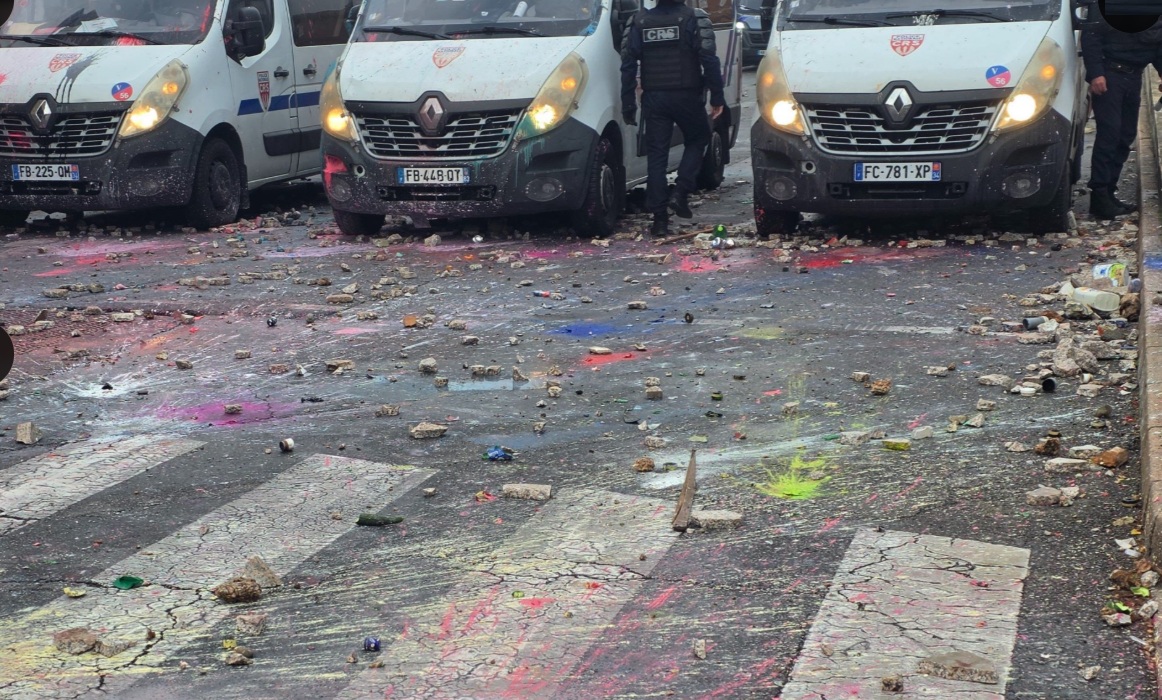
Authorities banned demonstrations in several cities, including Lyon, Nice and Montpellier, while shops in Paris were boarded up and museums closed as a precaution. The extensive security measures contained some of the disorder but failed to prevent violence. In Paris, a march attended by around 110,000 people began peacefully before masked demonstrators hurled objects and fireworks at police near the eastern end of the route. Officers responded with tear gas and water cannon. Fires were reported in Paris, Marseille and Lyon, while police used tear gas in Clermont-Ferrand, Strasbourg and Bordeaux, and water cannon in Nice and Nantes. In Marseille, where authorities estimated that 17,000 people participated, a peaceful demonstration deteriorated rapidly.
Several protest sites descended into chaotic scenes, with demonstrators throwing stones at police and confrontations taking on the appearance of street battles. The violence was particularly dangerous in some locations. In Nantes, demonstrators threw petrol bombs at police, and at least 70 people were arrested. In Bordeaux, more than 15,000 people reportedly gathered despite a ban on demonstrations. Some attempted to force their way into the Chamber of Commerce, and 44 people were detained. In Lorient, six suspects were arrested before a march after police found them carrying sledgehammers, bolt cutters and smoke bombs. What began last month as a student movement in the Paris region over staff shortages, deteriorating educational infrastructure and perceived unfairness in university admissions has since broadened considerably.
The government's failure to offer a convincing response turned the protests into a wider campaign against economic hardship and political discontent. Strikes and blockades spread, drawing in left-wing groups, trade unions and members of the Yellow Vest movement, whose earlier protests had also challenged economic inequality and government policies.
The latest mobilisation suggests that the grievances driving the movement extend well beyond education and may prove difficult for the authorities to contain through policing alone. The crisis has intensified pressure on President Emmanuel Macron, whose political authority has been weakened by mounting opposition and economic uncertainty. With Macron unable to seek another term in next April's presidential election he is being labelled as a "lame duck" whose influence is steadily diminishing.
The political vacuum has created opportunities for both the far right and the far left to challenge the centrist political establishment. The far-right National Rally (RN) sought to capitalise on the situation as it held the final day of its congress in Orleans on Sunday, as per local media reports. More than 10,000 people has reportedly protested in the city the previous day, prompting authorities to prohibit gatherings between 7 am and 10 pm because of the risk of further disorder. RN president Jordan Bardella was scheduled to address the gathering, followed by Marine Le Pen, who is launching her presidential campaign.
The party has accused the government of failing to protect the public and urged voters to channel their anger through the ballot box. meanwhile, on the left, Jean-Luc Melenchon has expressed support for the demonstrators while criticising police tactics, particularly after clashes left some teenage protesters with injuries that could have life-changing consequences.
The protests are not politically motivated rather economic pressures are compounding the political turmoil. French borrowing costs have been rising, while investors are demanding higher premiums to hold the debt of major eurozone economies. Analysts say the government faces a difficult dilemma: financial markets are pressing Paris to rein in public spending, while protesters are demanding greater investment in schools and public services and relief from the rising cost of living.
These issues have multiplied as the Ukraine-Russia war is in fifth year and demanding European countries to put in more finances in the defence sector to safeguard the borders. The unrest has also spread across Europe, with organisers adopting the slogan "Institut Indignats", echoing the French expression "Lycees Indignes" associated with the student protests. In Spain, around 100 people were arrested in Barcelona after hooded demonstrators looted shops and set fires. Catalan Interior Minister Nuria Parlon said about a quarter of those detained were minors. More than 30 fires were reported, and 14 shops were vandalised or looted. In Madrid, thousands of retirees marched against any privatisation of pensions ahead of next month's snap election, underscoring the wider anxieties surrounding social protection and economic security.
The next Prime Minister of Spain will be decided in a snap general election scheduled for November 29, 2026, called by current Prime Minister Pedro Sánchez. In Italy, demonstrations took place in Milan, Rome, Turin, Naples, Bologna and Florence. Police reported nine arrests and the brief detention of 371 people, including 110 minors. In Rome, some demonstrators forced their way into the Colosseum before being escorted out, while crowds in Milan chanted slogans against Prime Minister Giorgia Meloni.
Protests in Albania began on May 31, 2026, initially triggered by a controversial proposal of €1.4 billion luxury resort project on Sazan Island linked to Jared Kushner that lies within a protected nature reserve. The movement, dubbed the "Flamingo Revolution," drew opposition from those concerned about the project's environmental impact As riot police deployed water cannon and tear gas in Tirana as protesters set government buildings alight. Authorities said more than 300 protesters and police officers had been injured in clashes since mid-October.
Demonstrators have demanded lower tuition fees and an end to corruption, while some have called for Prime Minister Edi Rama to resign. Housing-related protests have also taken place in Lisbon and Montenegro, highlighting the breadth of public discontent over affordability and living standards. The unrest has also become part of a wider international political debate over immigration.
US President Donald Trump has sought to portray the violence as a consequence of immigration and what he regards as excessively permissive border policies. In political rallies and statements on his Truth Social platform, Trump has framed the turmoil as a threat to European identity and Western civilisation, arguing that governments must tighten immigration controls. "If Europe doesn't close its borders and bring the criminals out, like the people that are protesting, Europe is finished," Trump said.
Referring to France and Italy, he argued that the turmoil and hostility in European societies were not primarily about schools or economic grievances but about immigration. "When I look at France, when you look at Italy, when you look at all the turmoil and the hatred - that's not about school. That's about people coming into the countries that hate the country," he said.
Trump has also described the unrest as a "full-on revolution", claiming that migrants oppose Western civilisation and are undermining Europe's identity. He has maintained that he previously warned Macron to close France's borders, arguing that Europe risks losing its identity unless governments adopt drastic changes to immigration policy. His interpretation, however, places the protests within his broader political argument over border controls, while the demonstrations themselves have been driven by a range of grievances, including education, housing, pensions, living costs and corruption.
With governments across Europe preparing for further demonstrations and the French authorities yet to offer concessions capable of addressing the movement's central demands, the crisis shows little sign of fading. What began as a protest over the condition of educational institutions has evolved into a wider challenge to political leadership and economic policy, raising questions about whether European governments can restore public confidence without addressing the material pressures fuelling the anger.
UNI AAB SKA


