


Lavrov warns Germany over military ambitions, accuses Berlin of fueling Ukraine war, questions lessons of WWII
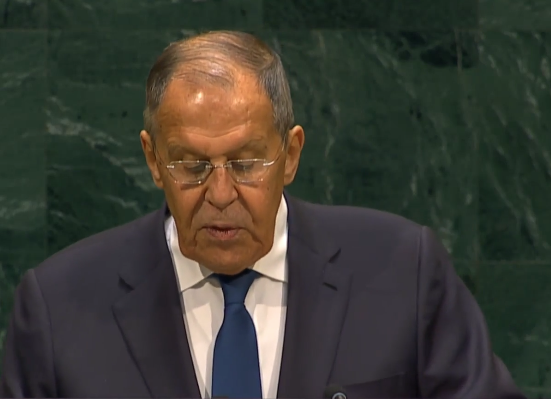
New York, Sep 27 (UNI) Russian Foreign Minister Sergei Lavrov used his address to the 81st session of the United Nations General Assembly to sharply criticise Germany's military ambitions, accusing Berlin of becoming Kyiv's main sponsor while seeking to build Europe's strongest conventional military.
Referring to German Chancellor Friedrich Merz's stated ambition to make Germany's armed forces the strongest conventional army in Europe, Lavrov questioned whether Berlin had considered the historical implications of such a policy.
"Chancellor Merz is stating that Germany must once again be leading military power in Europe," Lavrov said. "Does Berlin understand what this could lead to? Didn't they learn the lessons of World War II?"
Lavrov's remarks came a day after he met German Foreign Minister Johann Wadephul on the sidelines of the UN General Assembly in what was described as the first direct meeting between the Russian and German foreign ministers since before Russia's full-scale invasion of Ukraine in 2022. During the meeting, Wadephul urged Moscow to abandon what Germany described as a dangerous course of escalation.
In his UN address, Lavrov portrayed Germany's military expansion as particularly significant because of the country's history. He accused Western governments of consigning to oblivion Nazi Germany's responsibility for wartime atrocities, including what he described as the genocide of the Soviet people, while simultaneously supporting Ukraine with weapons.
"Germany is also Kyiv's main sponsor," Lavrov said, linking Berlin's backing for Ukraine to what he described as a broader Western effort to undermine Russia.
He accused the West of seeking to inflict a "strategic defeat" on Russia, but said the effort would ultimately fail. "The West aspires to inflict strategic defeat on Russia, but these aspirations will result in the warmongers being led into a strategic dead-end," he said.
Lavrov also accused European governments of obstructing diplomatic efforts to end the Ukraine war. "Europe is doing everything it can to thwart peace talks in which the Trump administration is interested," he said, while accusing Western countries of continuing to supply weapons to Kyiv that, in Moscow's account, are being used against civilian infrastructure.
The Russian foreign minister reiterated Moscow's position that the objectives of what Russia continues to call its "special military operation" remain unchanged and would be achieved despite external pressure. "The objectives of our special military operation will be achieved, and the threats to our security will be eliminated," he said. "Peace will reign again."
Lavrov also renewed Russian criticism of Ukraine's language policies, alleging restrictions on the use of Russian and questioning what he described as European double standards over the issue. Moscow has repeatedly cited the status of the Russian language and other cultural issues among its broader grievances concerning Ukraine.
Beyond Ukraine and Germany, Lavrov used the speech to address a range of international disputes. On Venezuela, he demanded the release of former President Nicolas Maduro and his wife, condemning what Russia described as the use of force and violations of international law.
On Iran, Lavrov criticised US and Israeli military actions and condemned the killing of Iran's Supreme Leader Ayatollah Ali Khamenei, describing the use of force against Iran's leadership as unacceptable. He also warned about the consequences of the conflict for navigation and trade in the Persian Gulf and the Strait of Hormuz.
On Gaza and the wider Middle East, Lavrov said the humanitarian situation remained critical and argued that the creation of a Palestinian state could not be delayed indefinitely. He warned that continued Israeli settlement activity in the West Bank could make a two-state solution increasingly difficult.
"If the situation continues, it won't be possible to set up a Palestinian state. There won't be any room," he said, adding that the failure to establish a Palestinian state would leave Israel's security under continuing threat. Russia has said the Palestinian statehood issue should be addressed on the basis of UN decisions.
Lavrov also criticised US policy towards Cuba, calling for an end to what he described as Washington's "siege" and urging the lifting of restrictions on trade with Havana. In the Balkans, he accused the European union of disregarding UN Security Council Resolution 1244 on Kosovo and alleged that Serbia was being pressured to impose sanctions on Russia in exchange for prospects of European integration.
Returning to Germany, Lavrov invoked the legacy of the Nuremberg Tribunal and World War II, arguing that its lessons had not been fully absorbed.
"80 years ago, the lessons of Nuremberg were not learnt by everybody," he said.
His remarks reflected Moscow's broader argument that the international system is moving towards a multipolar order and that Western powers are attempting to preserve dominance. Lavrov called for greater representation for Asia, Africa and Latin America on the UN Security Council, with Russia supporting permanent seats for India and Brazil.
The sustained criticism of Germany was among the sharpest elements of Lavrov's address, underscoring the continuing divide between Moscow and Berlin even as their foreign ministers resumed direct contact in New York. The exchange also highlighted the wider confrontation over Ukraine, European defence policy and the future shape of the international order. UNI AAB SKA


