


Canadian PM Mark Carney welcomes EU bid to become 'associate member' amid strained ties with US
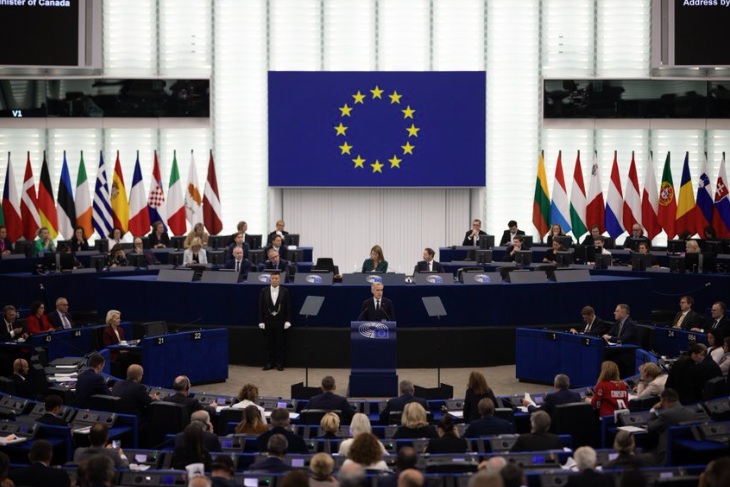
Ottawa, Sep 17 (UNI) Canadian Prime Minister Mark Carney welcomed the European Union's invitation for Canada to become its first "associate member" on Thursday, presenting closer ties with the bloc as a way for two longstanding allies to strengthen their economic and security resilience and reduce dependence on the US amid marked tensions with Washington.
Speaking to European Parliament lawmakers and European Commission President Ursula von der Leyen in Strasbourg, France, Carney confirmed Canada's interest in the proposal, which von der Leyen announced a day earlier in her annual State of the union address.
The terms of such an arrangement have yet to be worked out. Carney used the speech to present Canada as a natural partner for the 27-nation member bloc at a time of growing geopolitical and economic uncertainty, proposing closer cooperation on energy, critical minerals, defence, technology and artificial intelligence, alongside fewer trade and travel barriers and greater integration in areas such as education.
The speech came after another breakdown in Canada-US trade negotiations and a fresh exchange of tariffs between the two countries. Trump has been a strong critic of the proposed Canada-EU arrangement, warning that he could impose heavy tariffs on Europe if he regarded it as a hostile move. Carney sought to make clear that deeper ties with Europe were not intended to replace the US as an economic or strategic partner. "I am not proposing a third bloc in order to become a great-power rival, only with better manners," Carney said, drawing laughter and applause from lawmakers. "We do not seek power to dominate others.
On the contrary, we are pursuing resilience, so no one, no one can control our open markets, impair our sovereignty, threaten our territorial integrity, or undermine our freedoms, our democracies, our rule of law." He said Canada and Europe should strengthen their defence industries, work together on sovereign computing capacity and AI regulation, and make it easier for students to move between the two jurisdictions.
"We are not fair-weather allies. We do not pursue zero-sum deals," Carney told the parliament. "Our commitment to the rule of law and our unyielding defence of human dignity, individual freedom, and democracy share the same deep roots, the same unwavering dedication." Canada, he said, could provide Brussels with energy, including natural gas and hydrogen, as well as critical minerals needed for the coming decades.
In return, Ottawa could contribute to European defence procurement and development and work with Europe on building "sovereign compute power" to reduce dependence on foreign technology companies. Carney also proposed that Canada join Erasmus , the EU's student mobility and exchange programme, whose budget is €26.2 billion. "Canada and Europe should consider exploring an integrated market for financial services to broaden choice and reduce costs for our citizens," he said. Carney also criticised the growing use of tariffs and trade pressure by the US, without directly naming Trump.
"Today, our societies are being shaken by new storms: the upheavals linked to climate change, the erosion of democratic norms, and the use of trade as a weapon," he said. "Economic integration is now being used as a weapon, and tariffs as a means of pressure. Financial mechanisms are being used for coercive purposes," he added in French. Carney drew considerable attention in Strasbourg. His speech was delayed by around 10 minutes as European lawmakers gathered around him to shake hands, exchange words and take photographs.
German Green lawmaker Terry Reintke wore a Sidney Crosby Team Canada jersey while posing for a picture with the Canadian prime minister. As Carney began speaking, Siegbert Droese of the right-wing Europe of Sovereign Nations group shouted "USA! USA!", drawing groans from other lawmakers and a laugh from Carney. The speech was repeatedly interrupted by applause and ended with a standing ovation from most of the chamber, while members of the parliament's far-right group largely remained silent.
Trump reacted angrily to von der Leyen's proposal on Wednesday, calling the idea of Canada becoming an associate EU member "laughable" and warning that Europe could face heavy tariffs if he viewed the move as hostile. Carney said afterwards that closer Canada-EU relations could ultimately benefit Washington as well. "It will make Europe stronger. It will make Canada stronger. It will make Canada a better partner with the United States," he told reporters.


