


Australia, Philippines seal Defence Pact to strengthen maritime security in Southeast Asia
Arti Bali
New Delhi, Nov 15 (UNI) Australian Prime Minister Anthony Albanese on Sunday announced a new Defence Cooperation Agreement with the Philippines to strengthen maritime security, enhance intelligence and information-sharing, and deepen military ties amid growing regional security challenges.
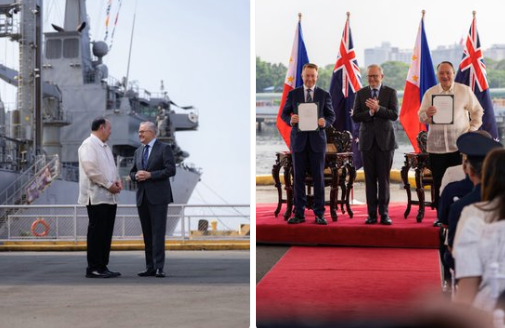
Albanese witnessed the signing of the agreement during his visit to the Australian naval vessel HMAS Stalwart in Manila, as the two countries marked the 80th anniversary of the establishment of diplomatic relations.
Addressing Australian Defence Force personnel aboard the ship, Albanese said the agreement would provide a framework for expanding defence cooperation, improving maritime awareness and information-sharing, and strengthening strategic dialogue, joint planning, training, interoperability and defence infrastructure development.
"There are three main elements to this agreement. Firstly, it'll guide our priority areas of cooperation. Secondly, to enhance our maritime awareness activities and information sharing. And thirdly, to increase our strategic dialogue, planning, training, interoperability, and defence infrastructure development," he said.
Albanese also announced additional Australian investment in the Philippines' maritime domain awareness and capabilities, including drone technology, improved detection of maritime and cyber security threats, equipment and training.
"Today's announcement reflects the maturity of our defence relationship. These activities will contribute to making our region more safe, more secure, and more prosperous," he said.
Highlighting the longstanding military ties between the two countries, Albanese recalled that more than 1,000 Australians had lost their lives in the Philippines and surrounding waters during World War II. He also noted that Australian and Filipino forces had served together during the Korean War and as part of the International Force East Timor.
Australia's defence cooperation with the Philippines currently encompasses up to 200 separate activities, involving between 2,500 and 3,000 Australian Defence Force personnel. Albanese also highlighted Australia's largest-ever contribution to the Philippines' flagship military exercise, Balikatan, in 2026, which brought together seven participating nations.
Amid questions over China's growing influence and activities in the South China Sea, the Australian Prime Minister stressed that the agreement is not directed against any particular country.
"This isn't aimed at any one country. This is about supporting sovereignty of every country. It's also, we very strongly support the international law of the sea," he said, underlining the importance of freedom of navigation.
"The majority of our trade goes through the South China Sea. That is important. This is about, not about any one country. It's about peace and security in our region," he added.
Albanese said Australia supported a regional order in which the sovereignty and territorial integrity of all countries are respected and nations remained free to make their own choices.
In a joint statement, he reaffirmed Australia's commitment to working closely with the Association of Southeast Asian Nations (ASEAN) to promote a peaceful, stable and prosperous Indo-Pacific region.
"Our new Defence Cooperation Arrangement will strengthen defence and maritime security ties, while increased investment in Southeast Asia Maritime Partnerships addresses shared maritime challenges," he said.
Australian Foreign Minister Penny Wong said Canberra's interests lay in a region where sovereignty is respected, international law upheld and countries were free to determine their own futures.
"Together with the Philippines and our regional partners, we are strengthening maritime resilience and security that helps underpin a peaceful, stable and prosperous region," she said.
Turning to the wider international security situation, Albanese said the world is witnessing more conflicts than at any time since World War II, citing the ongoing wars in Ukraine and the Middle East.
He said the conflict in the Middle East is having a significant impact on global inflation, placing mounting economic pressure on countries across the region. Citing the Philippines, he said inflation, which had been around two per cent at the beginning of the year, had climbed to approximately seven per cent.
"We'll be discussing how we can work together to mitigate the impacts of the war, but also we want to see a de-escalation," he said.
Albanese said he would engage diplomatically with US President Donald Trump on the conflict and its economic consequences, adding that the US administration is aware of Australia's strong desire for de-escalation.
He emphasised that the repercussions of the conflict extended well beyond the countries directly involved, affecting economies across the world, including those of the United States, Australia and the Philippines.
On the Russia-Ukraine war, Albanese reiterated Australia's support for Kyiv and condemned Moscow's invasion as "illegal and immoral".
He also reaffirmed Australia's commitment to freedom of navigation, including through the Strait of Hormuz, stressing that uninterrupted international trade remain vital to the country's economic interests.
"One in four Australian jobs depend on our trade," he said.
On artificial intelligence, Albanese said governments needed to establish national standards while working towards appropriate international regulation. He acknowledged the technology's considerable potential to generate economic opportunities and improve healthcare, but cautioned that its associated risks also needed to be addressed. UNI AAB SKA


