


Why Indian Manufacturers Are Turning to Predictive Maintenance : The Hidden Cost of Unplanned Downtime

When a machine stops, production stops with it, and somewhere on the floor, a supervisor is already doing frantic math. How much is this hour costing? Repairs get counted. Lost hours rarely do. And that's the problem. The real damage usually sits in the hours nobody tracks. This is why plant leaders are rethinking how they maintain equipment. It's also why predictive maintenance keeps coming up in every serious conversation about protecting output and margins today.
The Downtime Crisis in Modern Manufacturing
Unplanned stoppages are a major concern for any plant manager. Machines don't warn you first. They just stop, often at the worst possible moment in a production run.
What is predictive maintenance in manufacturing? Predictive maintenance in manufacturing means using IoT sensors, real-time telemetry, and AI analytics to catch equipment problems early. Teams act on actual condition data instead of a fixed calendar. Rigid overhaul schedules get replaced with timely, evidence-based fixes.
The escalating price of system outages in India is worth sitting with. Domestic demand is climbing. Export timelines are tighter than ever. Margins are thinner too. Traditional maintenance models were built for a slower era. They simply weren't designed for this pace.
The True Financial Impact of Unplanned Production Halts
A breakdown never shows up neatly on the balance sheet. It hides. What looks like a routine repair invoice is often just the tip of something bigger. Trace the ripple effects and the real number gets uncomfortable fast. Knowing where that money leaks is step one.
Direct Costs vs. Hidden Indirect Losses
Repair bills are easy to spot. The real damage isn't. Picture scrapped raw materials on a line that suddenly went dark. Or a batch discarded because temperature drifted mid-cycle. Add emergency freight charges for rushed parts, overtime wages, and contractual penalties for missed deliveries. None of this shows up as one tidy line item. Together, though, it often dwarfs the original repair cost by a wide margin.
Equipment Degradation and Secondary Failures
A single failure rarely stays contained. For example, when a worn bearing overheats, it can increase motor loading, accelerate gearbox wear, and eventually lead to unexpected equipment shutdowns. One quiet fault can become a chain reaction. The original problem is often the cheapest part to fix.
Overall Equipment Effectiveness (OEE) Erosion
OEE rests on three pillars: Availability, Performance, and Quality. An unplanned stop hits all three at once. Availability drops the second the machine goes idle. Performance suffers too, as operators restart cautiously, wary of another failure. Quality may also be affected during startup and recovery phases, when process conditions have not yet fully stabilized. Small losses. But they compound fast over a quarter.
Core Architecture of Industrial Predictive Maintenance Solutions
So how does industrial predictive maintenance actually work? It isn't one piece of software bolted onto old machines. Think of it as layers. Sensors collect data at the equipment level. Gateways move that data along. Algorithms interpret it, trained to spot the early signs of wear. Each layer depends on the one before it. Skip a layer and the whole system underdelivers. Sensors without proper analytics, for example, just generate noise and not insight.
Multi-Sensor Data Capture
Everything starts at the source. Vibration analysis catches abnormal frequencies in rotating equipment long before a human ear would notice. Infrared thermography flags hotspots forming in electrical connections or bearings. Acoustic ultrasound picks up the faint hiss of an air leak or an early bearing fault. Power quality and current signature analysis reveal electrical stress hiding inside motors that look and sound perfectly fine.
Edge Gateways and Cloud Analytics
Raw sensor data sitting on the machine isn't useful on its own. Edge gateways collect it locally, filter out the noise, and forward what matters to cloud platforms. There, algorithms compare live readings against historical baselines, in near real time.
Cybersecurity and Secure Data Exchange
As industrial systems become more connected through IoT sensors, edge gateways, and cloud analytics, cybersecurity becomes an essential part of predictive maintenance deployment. Secure communication, controlled access, network segmentation, and appropriate data-protection measures help protect equipment data and connected operational systems.
Machine Learning & Remaining Useful Life (RUL) Modeling
This is where predictive maintenance solutions earn their name. Machine learning models train on historical failure patterns, matching sensor drift to actual breakdowns recorded over time. From that, they calculate a Remaining Useful Life estimate for critical parts. Essentially, an estimate of the remaining operational life of a component based on current condition and historical trends. No more relying solely on fixed maintenance intervals. Teams schedule work during a real window, calculated from actual wear trends, not a date pulled from a generic manual.
Condition Monitoring Platforms and CMMS/EAM Integration
Predictive maintenance delivers maximum value when condition monitoring platforms are integrated with Computerised Maintenance Management Systems (CMMS) or Enterprise Asset Management (EAM) platforms. Alerts can then trigger maintenance workflows, support automatic work-order creation, and contribute to asset history records. This connects equipment condition data directly with maintenance execution. For electrical assets, solutions such as SmartComm Predict can support condition monitoring, asset health insights, and predictive maintenance planning.
Why Indian Manufacturers Are Rapidly Adopting PdM
This shift isn't happening by accident. Plants in India run in conditions that punish equipment harder and faster than in many other regions. The economics of downtime have become impossible to ignore. Export contracts leave almost no room for slippage. Domestic buyers expect consistency, batch after batch. What used to be a nice-to-have is now treated as a survival strategy. Predictive maintenance in manufacturing fits squarely into that shift.
Overcoming Harsh Operating Environments
Indian manufacturing hubs face a specific set of stresses. Ambient heat pushes electrical components close to their thermal limits, for months at a time. Dust is a constant concern in textile and cement plants. Power quality variations, including voltage fluctuations, can place additional stress on electrical equipment in certain industrial environments. Add heavy, near-continuous production cycles on top. Equipment simply wears out faster here than it would elsewhere.
Transitioning from Reactive Fixes to Smart Manufacturing
For decades, the shop floor ran reactive. Something broke, someone fixed it, everyone moved on to the next fire. That culture is fading. Not gently, either. Plants are restructuring around planned, condition-based cycles instead of constant firefighting. It's a genuine culture shift, not just a purchase order. It asks maintenance teams to trust sensor data over instinct built up over years on the floor.
Sector-Specific Adoption Trends
Adoption isn't uniform. Automotive plants lean on predictive maintenance to protect tightly synced assembly lines, where one stalled station halts everything downstream. Steel producers use it to guard continuous, high-heat processes that are brutal to restart. Textile units track spindle and motor wear across thousands of running hours. Pharma values it for regulatory traceability as much as uptime. CPG firms use it to protect packaging line speed during peak season.
Reactive vs. Preventive vs. Predictive Maintenance
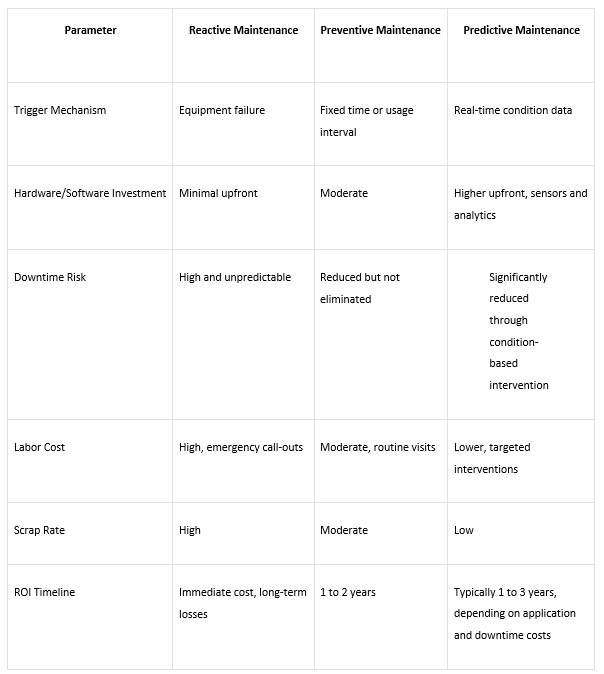
Not every maintenance strategy is equal. The differences matter more than they first appear. Reactive maintenance waits for failure. Preventive maintenance follows predefined maintenance intervals based on operating hours, usage, or manufacturer recommendations. Predictive maintenance acts on actual condition instead. Laid out side by side, the differences are easy to see, and easy to justify to a finance team weighing the spend.
Step-by-Step Roadmap to Implementing Predictive Maintenance
Rolling out predictive maintenance solutions across an existing plant is not a big-bang project. Treat it that way, and it usually backfires. It works better as a phased journey. Start narrow. Expand once the approach proves itself on a handful of critical assets. Each phase builds on the last, giving teams time to trust the data before betting the whole operation on it.
Phase 1: Critical Asset Identification & Auditing
Every plant has a handful of machines where failure hurts more than others. Cost, safety, or position in the line all play a role. This phase means mapping those assets, auditing their current condition, and reviewing past failure records. The goal is a short, prioritised list. It is not an attempt to monitor everything at once, which spreads budget and attention far too thin to matter.
Phase 2: Sensor Retrofitting on Legacy Brownfield Machinery
Most Indian plants aren't greenfield builds. They run legacy machinery, some of it decades old. Retrofitting means fitting vibration, thermal, and current sensors onto existing equipment, without stopping ongoing production. It takes careful engineering. Older machines weren't built with sensor mounts in mind. Still, it's achievable, with the right retrofit hardware and a bit of planning.
Phase 3: Pilot Deployment & Machine Learning Model Calibration
Before scaling anything, run a pilot on the priority assets for a few months. This period calibrates machine learning models against real plant conditions, since generic models rarely fit a specific machine's behaviour straight out of the box. Alerts get fine-tuned here too, cutting down false positives. That matters. It builds trust among the operators who act on these alerts every single day.
Phase 4: Full Plant Integration with EAM/ERP Workflows
Once the pilot proves reliable, integration expands plant-wide. Alerts feed directly into existing Enterprise Asset Management or ERP systems, generating work orders automatically. No more manual dashboard checks. This closes the loop between detection and action. It turns predictive insight into a real operational workflow, not an isolated monitoring exercise sitting apart from daily plant routines.
Conclusion
Organisations like Lauritz Knudsen Electrical & Automation have long supported Indian industry with the electrical and automation expertise behind this shift, helping plants move from reactive firefighting toward a steadier, data-informed way of running their operations. Beyond reducing downtime, predictive maintenance can improve asset utilisation, extend equipment life, optimise spare-parts inventory, and support more predictable maintenance budgets.
Disclaimer: The above press release comes to you under an arrangement with PR agency. UNI takes no editorial/ legal responsibility for the same.


