


Which Call Centre Calls Should Businesses Automate First? A Use-Case Framework With ConvoZen
More companies are deploying voice artificial intelligence (AI) to handle high call levels, streamline processes and increase response speeds. However, inappropriate automation can result in failed projects, despite initially positive outcomes.
Initial automation should avoid high complexity and emotionally charged discussions. Companies should start by automating standardised, simple queries so effective processes can be developed and then progressively broaden the scope of automation.
Why Businesses Should Focus On Automating Calls
Many contact centre resources are spent answering common calls. People regularly seek information regarding orders, bookings, billing and general account details and agents will often perform similar processes when responding to these calls.
By automating appropriate calls, organisations can standardise processes and free up staff to address more judgement and people-focused areas.
There can also be a considerable cost benefit. According to Gartner’s 2024 customer service benchmark, the median cost for a self-service interaction was around ₹171 whereas this rose to c.₹1,253 for an assisted one. Thus, assisted interactions are typically around 7.3 times more expensive. Only 14% of customer service problems were completely solved via self-service so it is vital that automation is used to effectively solve, not just re-route, issues for customers.
Considerations To Assess Suitable Call Automation
Prior to deciding which area of a business to automate, assess it according to the following factors;
- Volume: How frequently does the enquiry occur? High-volume categories offer more opportunities for efficiency gains.
- Repetition: Do calls follow predictable patterns, such as checking delivery dates or confirming appointments?
- Complexity: Can the query be resolved through information retrieval and a few predefined actions, or does it require negotiation and discretion?
- Sensitivity: Does the interaction involve complaints, financial hardship or distress that requires human judgement?
- Integration and Compliance: Can AI securely access the required business systems, retrieve accurate information and follow relevant policies?
A use case that scores well across these factors is generally a stronger starting point for automation.
Which Call Centre Use Cases Should Businesses Automate First?
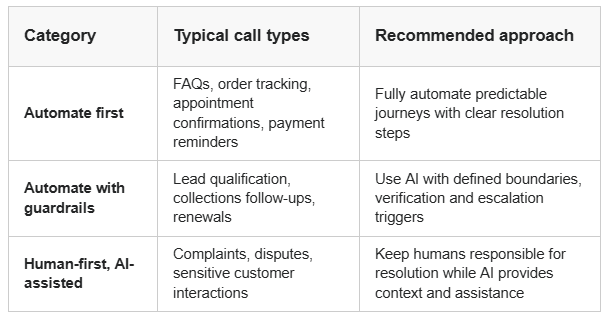
These criteria help divide call types into three practical categories.
How ConvoZen's Akshara STT and Ragini TTS Work Together
Consider a customer calling to check an order status in Hindi or Hinglish.
The customer asks, "Mera order kab tak deliver hoga?"
The interaction involves three stages:
Akshara STT (Speech-to-Text): Akshara recognises the customer's spoken query and converts it into text. It handles the listening stage, helping the system understand multilingual and conversational speech.
Conversational AI workflow: The system identifies the order-status intent, retrieves the relevant information from the connected business system and prepares an appropriate response.
Ragini TTS (Text-to-Speech): Ragini converts the response into natural spoken language so the customer can hear the update.
For example, the customer might hear: "Aapka order kal tak deliver hone ki sambhavna hai."
The customer receives the information without waiting for a human agent. If the order details are unavailable or the request falls outside the approved workflow, the call can be escalated.
Akshara supports the speech-recognition stage, while Ragini handles spoken responses. Together, they support the listening and speaking components of a voice AI interaction.
Explore Akshara Speech-to-Text and Ragini Text-to-Speech.
What Do Successful Automation Use Cases Look Like?
ConvoZen's customer examples illustrate how different businesses can approach call automation.
Jana Small Finance Bank used multilingual voice AI for customer outreach and collections-related journeys. Its deployment reported a 10% increase in resolution rates, demonstrating how structured banking interactions can benefit from voice automation.
Pilgrim, a D2C brand, experienced customer-support demand that increased five to seven times during sales periods. Its deployment reported a 73% bot resolution rate, a 34% reduction in agent transfers and a CSAT score of 4.25.
These examples highlight two different requirements: multilingual customer engagement in banking and repetitive-query handling during retail demand spikes.
30 Day Programme to Determine Initial Use Cases
Businesses can adopt a straightforward methodology underpinned by data analysis to determine their initial automation use cases.
Day 1-7 - Analyse call data from the last 3 months to determine the most common types of enquiry.
Day 8-14 - Apply a 5 point rating system to the top 10 enquiry types.
Day 15-21 - Choose an appropriate use case, design the resolution process and decide on escalation protocols.
Day 22-30 - Conduct a test implementation and analyse resolution, escalation and re-call rates.
Conclusion: Start With Calls That Are Easier to Resolve
Successful call automation begins with selecting the right use case, not automating the most complicated interaction. Businesses should start with high-volume, predictable enquiries, retain human oversight where needed and expand gradually.
Reliable speech recognition and natural voice responses also matter, particularly in multilingual markets. When customers can speak naturally and receive clear, accurate answers, voice AI becomes a practical extension of customer support rather than another barrier to resolution.
Disclaimer: The above press release comes to you under an arrangement with PR agency. UNI takes no editorial/ legal responsibility for the same.


