


Everything You Need to Know About EOR Services in India
India has quietly become the default answer for US companies that need engineering, finance, design, and customer teams without US salary bills. The talent pool is deep, English is the working language of corporate India, and pay for skilled roles runs a fraction of Bay Area or New York rates. Finding the people was never the hard part. Employing them legally was.
Registering a private limited company in India, opening a local bank account, and standing up payroll and statutory compliance can take two to three months plus an ongoing legal and accounting overhead you may not want before you have proven the market. An Employer of Record removes that barrier entirely.
What is an Employer of Record?
An Employer of Record (EOR) is a company that becomes the legal employer of your India-based staff on paper while you keep full day-to-day control of their work. The EOR issues a compliant employment contract, runs monthly payroll in Indian rupees, deducts and deposits Tax Deducted at Source (TDS), registers each hire with the Employees Provident Fund Organisation (EPFO) and, where the salary threshold applies, the Employees State Insurance Corporation (ESIC), and files the returns that keep everything above board. You assign the work, review performance, and integrate the person into your team. The EOR carries the employment liability.
For a US business the practical effect is speed and safety. You can extend an offer to a developer in Pune or Bangalore and have them onboarded compliantly in days rather than months, without triggering the permanent-establishment risk that comes from operating in a country on your own. This matters more in 2026 than it did even a year ago, because India rewrote the foundations of its employment law in late 2025.
The 2025 labour code overhaul US employers keep missing
On November 21, 2025, India brought all four of its new labour codes into force at once: the Code on Wages, the Industrial Relations Code, the Social Security Code, and the Occupational Safety, Health and Working Conditions Code. Together they replaced 29 older central labour laws. The Social Security Code became fully operational from April 2026, with central rules rolling out across the year.
The single change with the biggest payroll impact is the new definition of wages. Basic pay plus dearness allowance must now make up at least 50 percent of total compensation. Many Indian salary structures were historically built to keep basic pay low so that provident fund and gratuity liabilities stayed small. That workaround is closing, which raises statutory contributions on a lot of existing packages. A US employer running its own payroll would have to catch this. A capable Employer of Record already has.
What an EOR handles in India
A full-service EOR in India typically takes care of:
- Compliant employment contracts aligned to the new labour codes and the relevant state Shops and Establishments Act
- Monthly payroll, payslips, and TDS deduction and deposit
- EPF and ESI registration, contributions, and statutory returns
- Gratuity and statutory bonus accruals
- Professional tax and Labour Welfare Fund where the state requires them
- Leave, maternity benefit (26 weeks under the Maternity Benefit Act), and public holidays
- Onboarding, offboarding, and full-and-final settlements
A reliable provider of Employer of Record Services India will also localise the benefits Indian candidates expect but that are not strictly mandatory, such as private health insurance for the employee and their family, which strengthens your offer in a competitive hiring market.
EOR vs setting up your own entity
The two ways to employ someone in India are to use an EOR or to incorporate your own private limited company. They serve very different stages of growth.
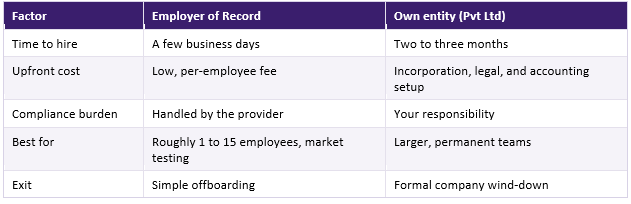
A widely cited rule of thumb is that a local entity starts to make financial sense somewhere past 10 to 15 employees, depending on salaries and cities. Below that, an EOR is almost always faster and cheaper.
How much do EOR services in India cost?
Your total monthly cost per employee has four parts: the gross salary, the employer statutory contributions, the EOR service fee, and any add-ons. Statutory employer contributions in India generally add 15 to 25 percent on top of gross salary. The main components are below.
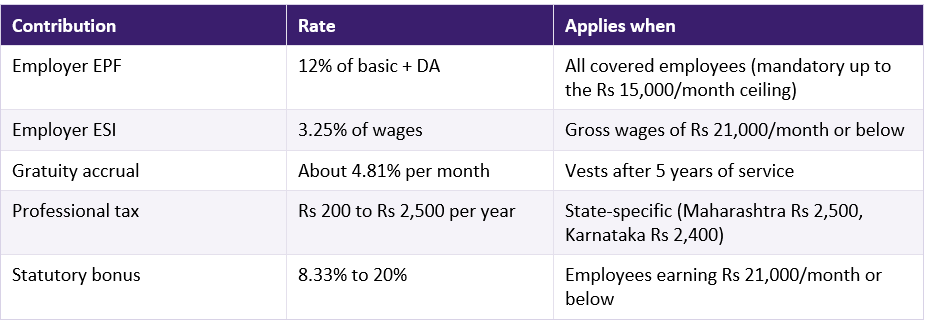
On the service fee itself, the spread is wide and often confusing. India-focused providers usually sit at the lower end because their overhead is local.
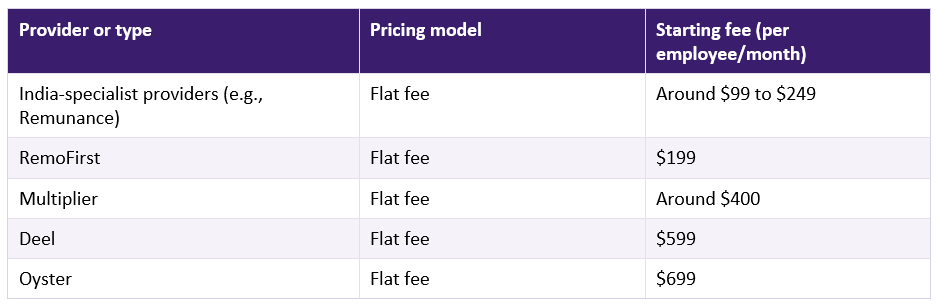
These are public starting prices and comparison-source figures as of early 2026. Every provider offers custom pricing by role, headcount, and contract, so treat them as brackets, not quotes. The gap between a $199 India specialist and a $699 global platform is mostly brand and dashboard polish, not better India compliance. What actually protects you is local depth and transparency on hidden costs.
The hidden costs to ask about
The headline monthly fee rarely tells the whole story. Before you sign, ask for an itemised quote that spells out:
- One-time setup or onboarding fees per employee
- Offboarding or termination fees, commonly $200 to $500
- Off-cycle payroll charges for bonuses or corrections
- Foreign exchange markups, often around 2 percent, which compound silently every month
- Security deposits held against payroll
A provider that lists all of this up front is usually the one worth trusting.
How to choose an Employer of Record provider in India
When you compare an Employer of Record provider India shortlist, weigh these six factors:
- India depth: is India a core market, or one flag among 150 countries?
- Compliance currency: can they explain how they handle the 2025 labour codes and the new wage definition?
- Transparent pricing: an itemised quote with no surprise line items
- Employee experience: local support, on-time payslips, and benefits Indian candidates value
- Data protection: readiness for India Digital Personal Data Protection (DPDP) Act obligations
- References: clients hiring in the same cities and roles as you
Conclusion
Hiring in India in 2026 is one of the highest-leverage moves a US company can make, but the compliance ground shifted under everyone in late 2025. An Employer of Record turns that complexity into a single monthly line item and lets you focus on the work rather than the paperwork. Start with a clear headcount plan, gather itemised quotes from two or three India-specialist providers, and pick the one that can explain the new labour codes without reaching for a script.
Frequently asked questions
What is an Employer of Record in India?
An EOR is a third party that legally employs your India-based staff, handling contracts, payroll, EPF, ESI, TDS, and compliance, while you direct their work. It lets you hire without registering an Indian company.
How much do EOR services in India cost?
Expect the EOR service fee to run from about $99 to $699 per employee per month, with India-specialist providers at the lower end. On top of that sit the gross salary and statutory contributions, which add roughly 15 to 25 percent.
Is using an EOR legal in India?
Yes. The EOR becomes the compliant legal employer under Indian law and registers with EPFO, ESIC, and the tax authorities. Choosing a provider that keeps pace with the 2025 labour codes is what keeps you safe.
What is the difference between an EOR and a PEO in India?
An EOR is the sole legal employer, so you need no local entity. A PEO co-employs alongside your own registered entity and shares liability. For US companies with no Indian presence, an EOR is the usual route.
When should I set up my own entity instead of using an EOR?
Typically once you pass 10 to 15 employees, or when you want a permanent, long-term base in India. Below that, an EOR is usually faster and cheaper.
What statutory benefits must an employer provide in India?
Provident fund (EPF), state insurance (ESI) for lower-wage employees, gratuity after five years, statutory bonus for eligible earners, paid leave, public holidays, and 26 weeks of maternity benefit.
How quickly can an EOR onboard someone in India?
A well-run India EOR can issue a compliant contract and onboard an employee within a few business days, versus the two to three months a new entity setup usually takes.
Disclaimer: The above press release comes to you under an arrangement with PR agency. UNI takes no editorial/ legal responsibility for the same.


