


Credit Card Minimum Due vs Total Due: What Happens If You Pay Only the Minimum?
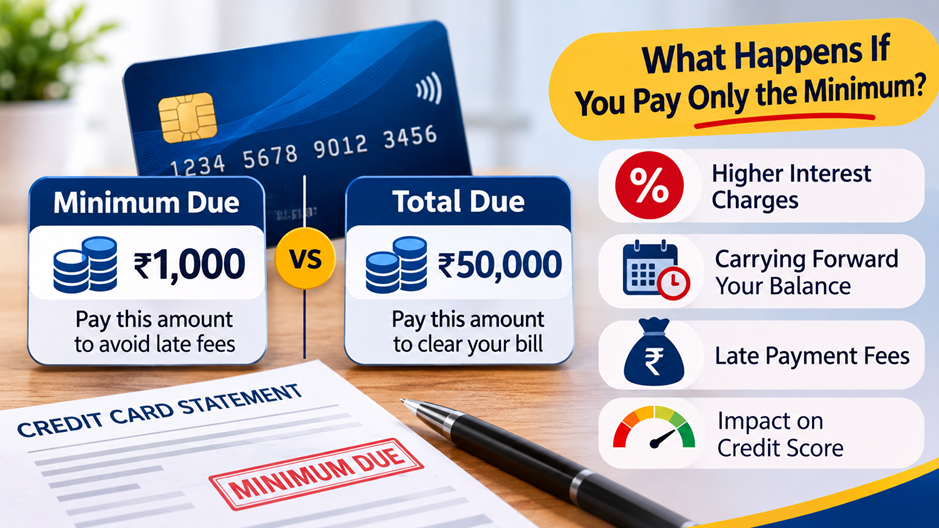
Every credit card user gets a monthly statement of their transactions on their credit card. The minimum amount due (MAD) and total amount due (TAD) are the most crucial figures in that statement. The former is the least amount a credit card user pays to avoid a late fee. The total amount due is the full credit card bill payment to close billing cycle of that month.
However, paying the minimum amount due everytime isn’t the smartest or wisest financial decision. It keeps your credit card account active but increases future financial burdens. These are important factors to consider before you apply for a credit card online. In this blog, we explore MAD and TAD, and financial possibilities.
What is the Minimum Amount Due on a Credit Card?
The Minimum Amount Due, or MAD, is the amount credit card holders pay to their bank by a specific due date. It helps them keep a clear repayment record and avoid late fees. It’s the smaller figure on your shopping or fuel credit card bill.
MAD is calculated using the formula of the card issuing bank. Typically, banks either calculate it as a percentage of the Total Amount Due (TAD) or apply a flat monthly fee. In a nutshell, you avoid late fees for the month if you pay the MAD. In the short term, it offers relief, but in the long term, this can hurt your pocket. Paying only the MAD every month means interest keeps accruing on the TAD, contributing heavily to future expenses.
What is the Total Amount Due on a Credit Card?
The Total Amount Due, or TAD, is the full credit card bill payment you need to clear. It includes new purchases, pending EMIs, GST, cash withdrawals, interest, and more. Paying the TAD brings your due amount to zero and closes a cycle. RBI rules reward credit card holders with an interest-free period if the overdue amount is paid within the due date. Moreover, paying the TAD on time also keeps financial obligations off your shoulders in the long run.
Difference Between Minimum Amount Due and Total Amount Due
The MAD and TAD differ in terms of the financial burden you bear after payment. Here’s a comparison table that clarifies:
| Aspect | Paying Minimum Amount Due | Paying Total Amount Due |
| Late fee penalty | Does not apply | Does not apply |
| Interest | Accrues for every month that TAD is not paid | Only accumulates for the months when the overdue amount wasn’t cleared |
| Interest-Free Period | Not rewarded | Rewarded |
Pay the Minimum Amount Due or the Total Amount Due: Which is Best?
An individual with financial discipline will advise paying the TAD. Paying only the minimum amount due comes with caveats that can snowball into financial problems unless managed smartly:
- The Balance Amount Grows Bigger
Paying the MAD only keeps the penalty fee for late payments away by 30 days. Interest keeps piling on the rest of the amount. Over time, the TAD can double and become a financial burden. In contrast, paying the TAD closes the cycle. You’re no longer looking at late fees or living in fear of unreal overdue bills.
- The Repayment Period Prolongs
When you pay the Minimum Amount Due for months on end, the repayment period for a specific statement cycle gets prolonged. It extends the time it will take for you to repay the full amount. The bill keeps burning a hole in your pocket for a longer duration.
- Credit Scores May Be Affected
When you use your shopping credit card frequently but do not clear the Total Amount Due half as often, the habit can reflect on your credit score. A good credit score is essential for securing future loans with minimal obstacles. Deflecting MAD payments and longer repayment periods can contribute to lower credit scores, making access to funds difficult in the long run.
Tips to Manage Minimum Amount Due Well
Even if your current finances allow you to pay only the MAD, it’s best to manage payments on time to avoid late fees. Here are a few tips that can help:
- Use auto-debit instructions to ensure the MAD is paid by the due date
- Pay slightly more than the minimum amount to reduce the figure incrementally
- Minimise or stop using the card for future transactions until TAD is paid off
- Seek balance transfer options, if available, to minimise interest accumulation
Kotak Mahindra Bank makes credit card acquisition easy for those looking to manage their credit card bills through a balance transfer. File your application for a credit card online and get instant approval along with exclusive discounts, gifts, and rewards on the card. Yearly card fee waivers are common if you meet the minimum spending limit. Fuel surcharge waivers are available across fuel stations through Kotak Credit Cards, too.
Conclusion
A certain degree of financial discipline is in order when you’re planning to use your credit card frequently. Paying the Minimum Amount Due by the due date or clearing the Total Amount Due if you have such a sum sitting in your bank account are part of that discipline. The latter ensures financial health in the long run. It gives you access to interest-free periods and reflects well on your credit score.
Disclaimer: The above press release comes to you under an arrangement with PR agency. UNI takes no editorial/ legal responsibility for the same.


