


J&K: 2,000-yr-old Buddhist site in Kashmir hailed by Modi faces collapse threat
Majid Jahangir
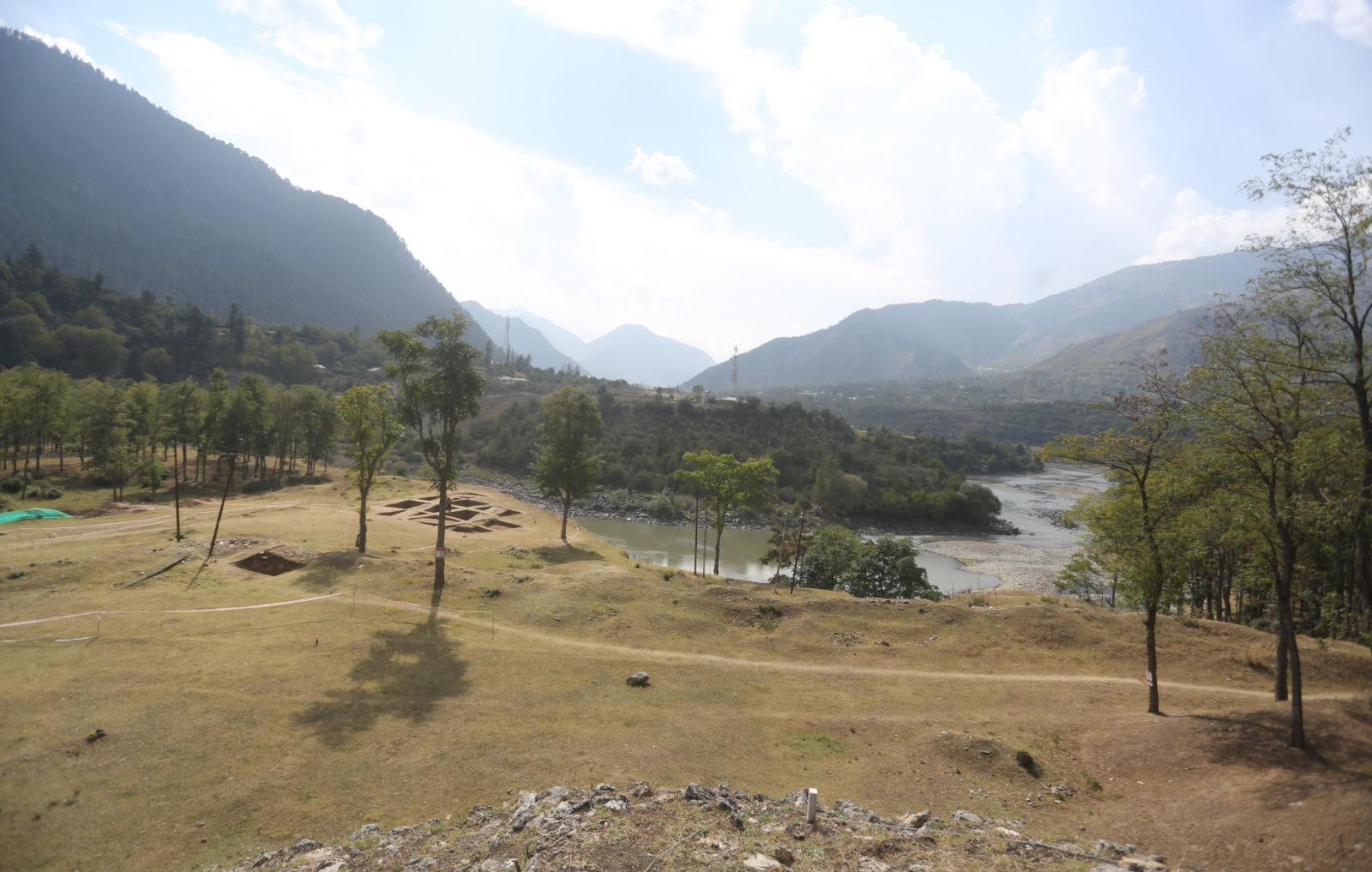
Srinagar, Oct 6 (UNI) A 2,000-year-old Buddhist archaeological complex in north Kashmir-described by Prime Minister Narendra Modi as a "proud moment" for the region's rich cultural heritage-is facing a threat from an altogether different force: the Jhelum River.
A recent study has warned that more than 10,000 square metres of land around the site could be lost by 2050, while the primary monument faces a high risk of collapse within the next three decades if protective measures are not undertaken.
The warning comes as archaeologists are carrying out excavations at the site for the second consecutive year, investigating an ancient Buddhist apsidal stupa complex believed to date to the first century AD, during the Kushan period.
The study, published in "Ancient Asia" in July 2026, used 46 years of satellite imagery and GIS analysis to map changes around the site between 1976 and 2022. It found substantial erosion and channel migration along the Jhelum, with the most intense phase recorded between 1989 and 2000.
During those 11 years, the average annual erosion rate surged to 3,616.09 square metres, compared with 818.15 square metres annually between 1976 and 1989 and 361.5 square metres between 2000 and 2022. Overall, researchers recorded 39,777 square metres of erosion during the 1989-2000 period.
The researchers attribute the exceptional erosion during that period to a combination of natural river processes and human intervention, particularly intensive and unregulated instream mining.
Mining pits altered the river's flow dynamics and shifted the deepest channel closer to the archaeological site, weakening the riverbank. The removal of riparian vegetation further reduced the bank's natural resistance to erosion, the study said.
Located on the right bank of the Jhelum, the Zehanpore complex comprises a linear arrangement of three stupas. Researchers have identified an area known as "Place A" as the epicentre of erosion, where archaeological deposits have been exposed to gravity-induced collapse, meander migration and direct cutting by the river.
Using the post-2000 erosion rate to make a linear projection, the researchers estimate that approximately 10,122 square metres of land could be lost between 2022 and 2050.
The authors, however, caution that the projection is intended as a conservation-management estimate rather than a deterministic hydrological forecast. It does not account for extreme flood events or possible non-linear changes in the Jhelum basin that could accelerate erosion.
More worrying, they said, is the vulnerability of the main monument itself.
"Our forecast indicates that the primary monument is at high risk of collapse within the next three decades if no protective measures are taken," the study said.
The researchers have recommended a combination of structural and nature-based interventions, including retaining walls, gabions and bio-engineering measures involving strategically planted deep-rooted vegetation, to stabilise the riverbank and protect the archaeological remains.
The findings have added urgency to the ongoing archaeological work at Zehanpore, a site that is offering new clues to Kashmir's little-known Buddhist past.
The complex is believed to have formed part of an ancient cultural and trade landscape linking Kashmir with Gandhara and Central Asia. Historical accounts cited by the researchers also connect the wider Baramulla region with Buddhist centres visited by the Chinese traveller and scholar Hiuen Tsang, who travelled through Kashmir in the seventh century.
The site attracted national attention in December last year when Prime Minister Narendra Modi highlighted it during his monthly radio programme Mann Ki Baat.
Referring to the discovery of the large stupas at Zehanpore, Modi described it as a "proud moment" for Jammu and Kashmir and spoke of the region's rich cultural heritage. He also recalled how an old, blurry photograph of three stupas preserved in a French museum helped draw attention to Kashmir's Buddhist past.
The archaeological excavations have since entered their second year, with researchers continuing to probe the apsidal stupa complex and its surrounding remains.
But the latest study suggests that archaeology may now be racing against the river.
The researchers said the Zehanpore case demonstrates how freely available satellite imagery and geospatial data can be used to diagnose threats to vulnerable heritage sites and guide conservation efforts.
The study provides, they said, a "clear, data-driven foundation" for policymakers and conservation agencies to move beyond passive monitoring and towards active intervention.
UNI MJR ARN


