


GRAP-III restrictions imposed across Delhi-NCR as AQI touches 382 ahead of Diwali
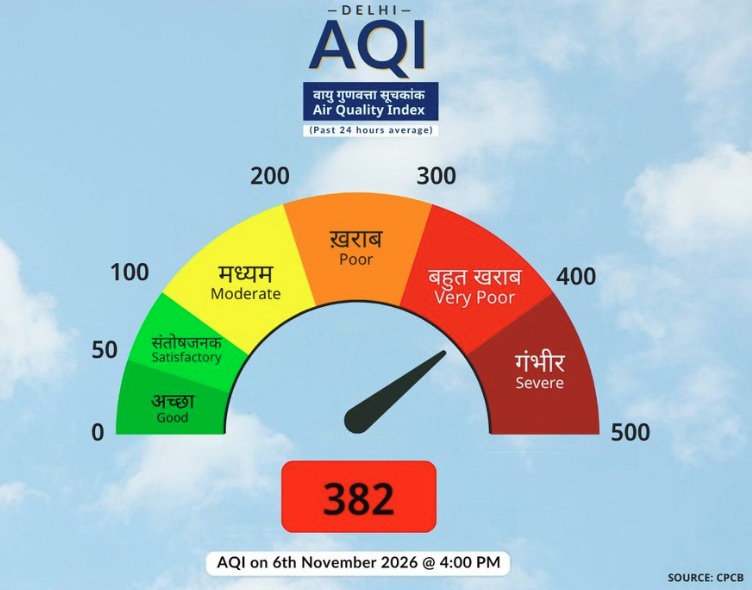
New Delhi, Nov 6 (UNI) With Delhi's air quality slipping into the 'very poor' category, recording an average AQI of 382 on Friday, the Commission for Air Quality Management (CAQM) invoked Stage III of the Graded Response Action Plan (GRAP) across Delhi-NCR with immediate effect, just days ahead of Diwali.
The decision was taken by the CAQM's Sub-Committee on GRAP as a precautionary measure amid rising pollution levels in the national capital and adjoining areas, triggering a fresh set of restrictions on construction activities, vehicular movement and industrial operations. Under Stage III, a ban has been imposed on dust-generating construction and demolition activities across the NCR. These include excavation, earthwork, piling, drilling, demolition, brickwork, road construction, open trenching, stone cutting, painting and polishing, as well as major welding and gas-cutting operations.
The restrictions also cover the operation of ready-mix concrete plants and the transportation of construction materials, including sand and cement, on unpaved roads. Stone crushers and mining activities across the NCR have been directed to shut down. However, essential infrastructure projects, including railways, metro networks, airports, hospitals, highways, flyovers, power transmission lines, sewage treatment plants and water supply facilities, have been exempted, subject to compliance with prescribed dust-control measures.
Projects related to national security are also permitted to continue. The pollution-control measures include curbs on older, more polluting vehicles. BS-III petrol and BS-IV diesel four-wheelers will face restrictions in Delhi and the NCR districts of Gurugram, Faridabad, Ghaziabad, Gautam Buddha Nagar and Sonipat. Additional restrictions will apply to certain diesel goods vehicles, including BS-IV and older medium goods vehicles registered in Delhi and specified light commercial vehicles registered outside the capital. Vehicles engaged in essential services and carrying essential commodities will be exempted.
The Stage III measures also provide for changes in school and office operations to reduce exposure to polluted air and limit vehicular emissions. Schools up to Class V in Delhi and the identified NCR districts have been directed to offer classes in a hybrid mode, allowing students and parents to opt for online education wherever feasible. State governments and the Delhi administration may also consider allowing public, municipal and private offices to function with 50 per cent staff strength, with the remaining employees working from home.
The Centre may separately decide on similar arrangements for its employees. The use of diesel generator sets has been restricted, except for emergency and essential services, while industrial units and other operations not complying with prescribed clean-fuel norms will face action under the GRAP framework. Meanwhile, the CAQM has urged residents to minimise private vehicle use, opt for public transport and carpooling, avoid unnecessary journeys and walk or cycle for short distances.
People have also been advised against using coal and wood for heating to prevent further deterioration in air quality. According to the GRAP classification, AQI readings between 201 and 300 fall in the 'poor' category, 301-400 in 'very poor', 401-450 in 'severe' and above 450 in 'severe plus'. Stage III is ordinarily associated with the severe category, but the CAQM can invoke it as a precautionary measure based on prevailing pollution trends and forecasts.
UNI PWS RSA


