


US Midterm Results: Little immediate relief for India on trade, tariffs, Iran risks
Jayanta Roy Chowdhury
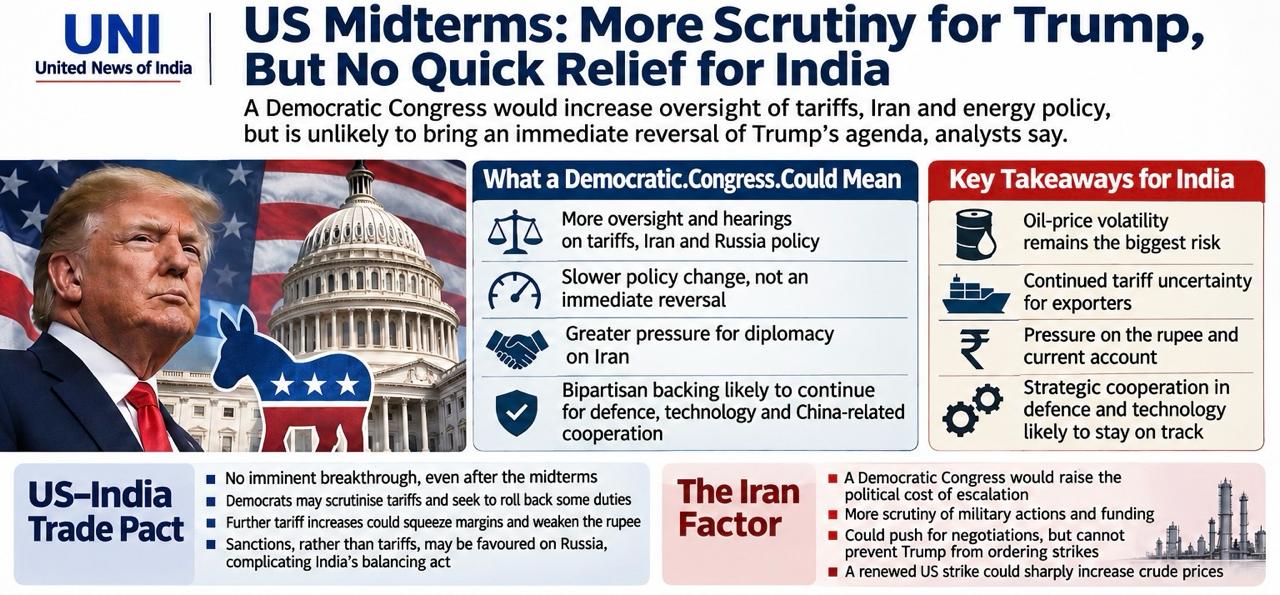
New Delhi, Nov 4 (UNI) The US midterm election results, which have given the Democrats control of both the Senate and the House of Representatives, may not automatically translate into a better trade deal for India, reduce the possibility of future sanctions over its trade with Russia, or reverse President Donald Trump's economic nationalism, which has had the whole world in jitters.
The more immediate consequence, according to Indian policymakers, is likely to be greater congressional scrutiny, political friction, and a slower pace of policy change.
"Democrats may seek tweaking of the trade deal as they feel India is a vital ally in facing up to China and Trump has been riding roughshod on Delhi. However, one has to realise that the era of US protectionism is not over and the deal is now at a stage where the executive possibly has more say than the politicians," said Pinak R Chakravarty, former Secretary (Economic Relations) in the Ministry of External Affairs.
Agreed Rupa Dutta, former Principal Economist with the Ministry of Commerce, who pointed out that the trade issue with India was one where partisan interests were less involved and national protectionist policies were more in the forefront.
"The deal will happen. The timeline may get shorter or longer depending on executive and political expediency," said Dutta, who now works as a Distinguished Fellow with Chintan Research Foundation.
New Delhi has considerable stakes in three interconnected areas of American policy: the proposed bilateral trade agreement, the conflict involving Iran, and the stability of global energy supplies.
A change in the balance of power in Washington could alter the political dynamics surrounding all three, but analysts feel it is unlikely to remove the economic uncertainties confronting the Indian economy.
The prospect of a Democratic Congress could complicate Trump's tariff strategy, but it offers little immediate reason for Indian exporters to anticipate relief, feel Commerce Ministry officials involved in the last round of trade negotiations.
Democrats are likely to intensify scrutiny of the administration's use of tariffs, demand greater transparency over their economic consequences, and potentially seek a rollback of selected duties. Congressional hearings could expose the costs imposed on American businesses and consumers by the administration's protectionist policies.
However, there is a significant constitutional and political obstacle to any swift reversal. The US President enjoys substantial delegated authority over trade policy, while President Donald Trump's veto could frustrate legislative attempts to dismantle his tariff framework.
"A Democratic majority would therefore have more power to investigate and challenge than to dictate an alternative trade policy," said officials.
This means the possibility of an early breakthrough in both bilateral trade deal negotiations or in talks to slash tariffs remains remote.
"The uncertainty itself is becoming an economic cost. Indian exporters need predictable access to the American market to make investment and production decisions," said Saibal Ghosh, CEO of a Delhi-based medium-scale engineering export house
The other major uncertainty concerns the conflict with Iran. While the Democrats may place US actions under scrutiny, that cannot happen till the new year kicks in, and in the interim, the US President may well take contrarian decisions.
"Now that the polls are done and dusted, Trump may feel that Iran still needs to be subdued … this would raise energy prices as the Persian Gulf-Red Sea region would be the zone for renewed conflict," pointed out Chakravarty, who has been on diplomatic postings in West Asia.
India's exposure to the Persian Gulf is well embedded in the structure of its energy economy. Roughly half of India's crude oil imports and about 90 per cent of its imported liquefied petroleum gas normally transit the Strait of Hormuz.
Higher energy prices, along with the possibility of the continuation of existing high tariffs, could squeeze margins, discourage new orders, and undermine business confidence. Any resulting deterioration in export prospects would also add to pressure on the rupee, which has risen over the past one year from a minimum of Rs 88.57 to a dollar to a current Rs 94.87.
A Bank of Baroda analysis forecasts the rupee will remain under pressure and is likely to move within the 94.75-95.75 range against the dollar in the near term.
UNI JRC RSA


