


The 'God of Machines' makes His way to the factory floor
Jayanta Roy Chowdhury
New Delhi, Sep 17 (UNI) Sometime in the latter half of the 19th century, a Vedic god credited with building cities such as Indraprastha, Dwarka and Lanka, as well as Stone Age aircraft, made a reappearance in the jute mills that formed the cornerstone of Bengal's industrial heartland.
The worship of Vishwakarma, the Engineer God in the Hindu Pantheon, colonial-era state archive records show, initially started as a tool worship phenomenon by Bengali and Bihari workers at jute mills in Howrah and Hooghly districts.
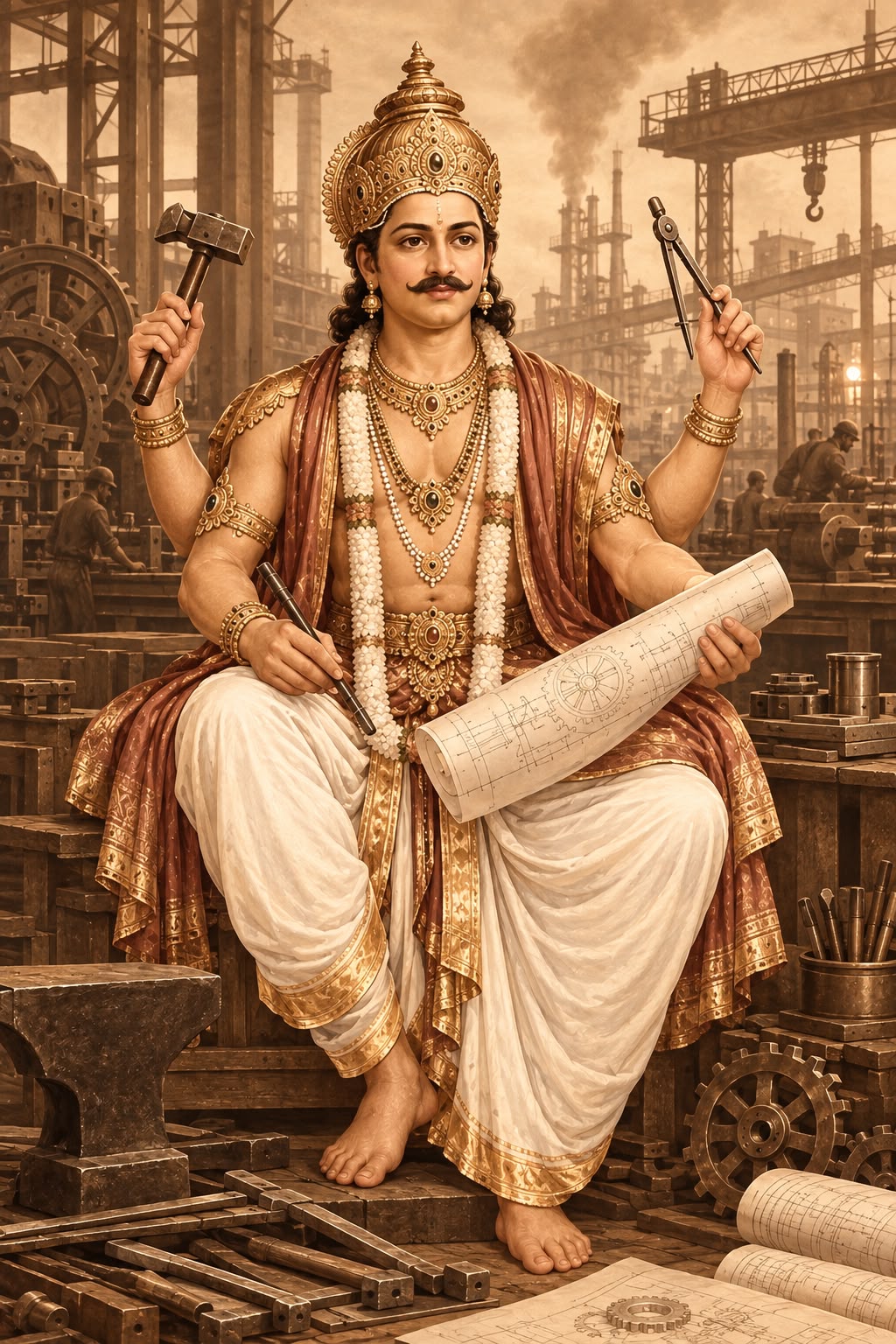
A Britisher, M M Underhill, writing about Indian festivals, noted that Vishwakarma was worshipped in some places simply as a pitcher, with tools and implements arranged before it. However, by the beginning of the 20th century, when Kolkata had become the jute capital of the world, Vishwakarma started taking shape as a handsome, clean-shaven man-god.
"Bengalis in the 19th century popularised two pujas or sacred days - the worship of Saraswati, the goddess of learning in the new English-style secular schools and colleges, and the worship of the Lord of machines, Vishwakarma." Jawhar Sirkar, former Culture Secretary to the Indian Government and researcher-author on Bengal's culture and religious iconography, told UNI.
The first Indian jute mill, Acland Mill, was established in Rishra, on the outskirts of Kolkata, in 1855, thanks to the collaboration between British entrepreneur George Acland and Bengali financier Babu Bysumber Sen.
Though the industry witnessed modest growth through 1870, it grew apace in the next decade, with the period 1871-75 alone witnessing the advent of as many as 18 mills. Jute became the 'El-Dorado' industry for India, proving highly profitable for investors. In 1873, the shares of Baranagore Jute Mill were selling at a premium of 68 per cent, and the company paid a half -yearly dividend of 25 per cent to stockholders.
"The workers who were showing their devotion to tools, sometimes between 1900 and 1910, agreed to an innovation- a sculptural representation as a clean-shaven God who became their Vishwakarma," explained Sirkar.
By 1910, India had 38 jute firms operating more than 140 mills with a total of 30,000 looms. Together, these firms exported more than a billion yards of cloth and over 450 million bags. All of it is presided over by the Engineer God of the Vedas.
Vishwakarma Puja spread to other burgeoning factories in Bengal - engineering firms such as Martin & Burn, started by Sir RN Mookerjee, the mechanised cotton mills, such as the Banga Laxmi Cotton Mills, which came up in Hooghly and Kolkata, and chemical and pharmaceutical factories whose pioneers were entrepreneur-patriots like Prafulla Chandra Roy.
"We have been holding Vishwakarma Puja in our factory for nearly 75 years," said Satarupa Mukherjee, managing director of the Swadeshi-era East India Pharmaceuticals, which was set up in 1936 by two friends -- Ashoke Kumar Sen and Hirendra Nath Duttagupta, both freedom fighters from Bengal.
For Swadeshi companies, the worship was a way of showing their connections to the country's roots, while for European-owned huge conglomerates, the puja was an HR tool to keep workers happy.
Vishwakarma Puja usually falls on September 17 or 18, depending on the almanac and individual factories' work schedules. Usually around the same time, the sun enters Virgo, supposedly a fortuitous time.
Machines that normally run through the day are switched off, and tools are cleaned and neatly arranged. Mechanics, drivers, artisans, and industrial workers gather around the objects on which their livelihoods depend and, for a day, treat them as sacred.
The Vishwakarma story begins in the Rig Veda, where he appears not quite as the familiar bearded craftsman of 'pop-art' calendars, but as a cosmic creator, an all-seeing deity with eyes, faces, and four arms, shaping heaven and earth, almost like Brahma, the creator.
The Puranas later gave this remote Vedic figure a spectacular bio-data, with Vishwakarma being credited with building Lanka, the 'golden city' ruled by Ravana, the demon-King; Dwarka, Lord Krishna's capital; Indraprastha of the Mahabharata fame; the palaces and weapons of the gods; and the mythical flying chariot Pushpaka Vimana. In short, he became ancient India's 'divine engineer', a figure of awe for later-day craftsmen.
In the medieval era, his worship was kept alive among guilds of goldsmiths, blacksmiths, carpenters, stone-masons, and sculptors.
As mills, foundries, railway workshops, and engineering establishments multiplied in Bengal in the second half of the 19th century, a new industrial society emerged, with a new class of workers whose lives were governed by machines.
This catapulted him to cult status not only as the god of the modern factories that were springing up in India, but also transformed him from being the god of a guild to the new god of machines.
UNI JRC RSA


