


Rajnath unveils policy push to deepen DRDO-industry ties; MSMEs, start-ups to get easier access to defence R&D
New Delhi, Sep 15 (UNI) Defence Minister Rajnath Singh on Tuesday unveiled a series of policy initiatives aimed at lowering technical and financial entry barriers for MSMEs and deep-tech start-ups and deepening their integration into India's defence manufacturing ecosystem.
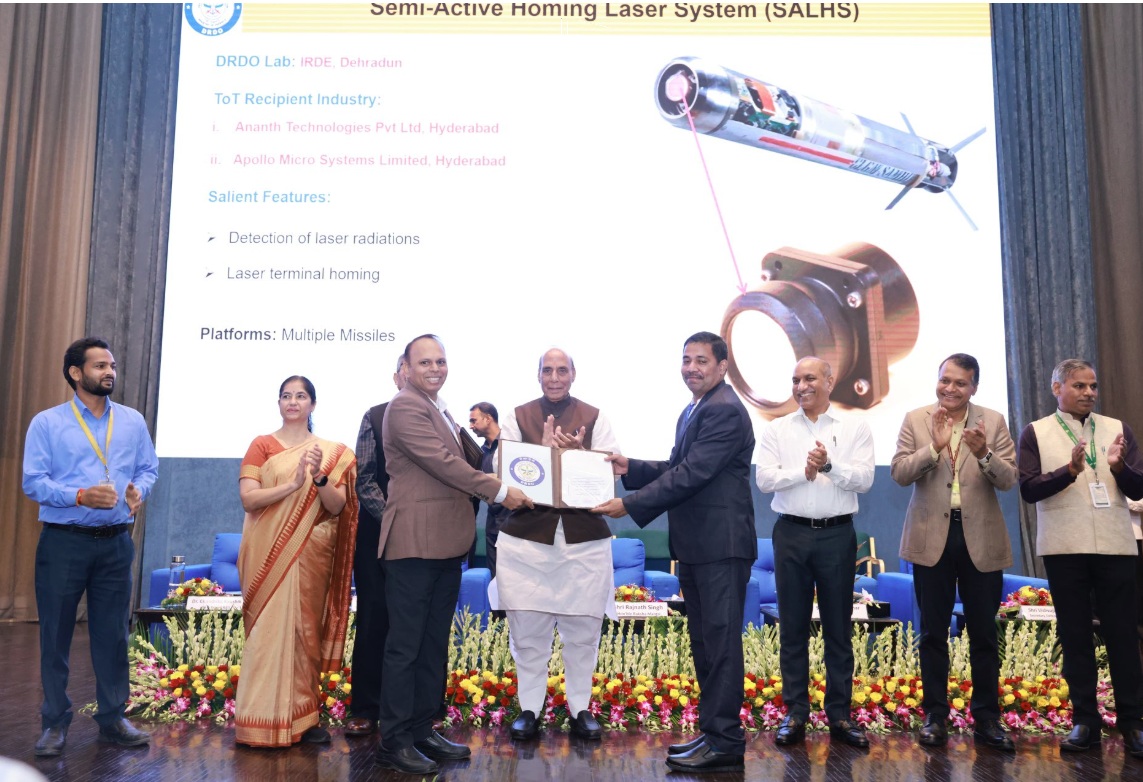
The initiatives, announced at the DRDO-Industry Synergy Meet 'VIMARSH 2026' here, include direct funding and incubation support for smaller enterprises, dedicated access to DRDO testing facilities and a standardised framework for sharing DRDO-developed software source codes with licensee industries. Nine Licensing Agreements for Transfer of Technology (LAToTs) have also been handed over to 13 manufacturing partners to facilitate commercial production of advanced defence systems. MoUs were exchanged with the Society of Indian Defence Manufacturers (SIDM) and Laghu Udyog Bharati (LUB) to expand DRDO's industry outreach and encourage greater participation at the grassroots level.
DRDO also signed a contract with the Quality Council of India for SAMAR 2.0, aimed at benchmarking the manufacturing maturity of domestic defence enterprises. Addressing the gathering, Singh said DRDO-industry cooperation needed to move beyond manufacturing and cover the entire defence technology value chain. "DRDO possesses knowledge and technology, the industry has scale and manufacturing capability, start-ups bring innovation and agility, and the youth hold the dream of a New India.
When these four forces converge and move forward together, no goal is impossible," he said. The Defence Minister said MSMEs and start-ups must become an integral part of the defence supply chain alongside large industries as India seeks to emerge as a global production hub. "MSMEs are the backbone of the Indian economy and a critical strength of the defence ecosystem.
They need to consistently focus on quality, delivery, innovation, and global standards, while expanding partnerships with large companies," Singh said. He said the country's transition from a defence importer to an exporter is creating opportunities in emerging areas such as drone technology, artificial intelligence and cyber security. Singh also linked the initiatives to the government's broader goal of achieving a technologically self-reliant India by 2047. "By 2047, we must achieve Aatmanirbharta in critical technologies, a significant increase in indigenous content, multi-fold growth in defence exports, and a robust presence for India in global supply chains," he said. Emphasising the strategic importance of indigenous technology, he said, "Companies that invest in new and emerging technologies today will become the leaders of tomorrow as in future warfare, the country that leads in technology will secure the strategic advantage." Singh said the government's defence reforms over the past few years, including Positive Indigenisation Lists, Make in India, iDEX and ADITI, has created a broader ecosystem for private-sector participation.
He also highlighted the decision to allocate 25 per cent of the defence R&D budget to the private sector and grants being provided to start-ups through the Technology Development Fund. The new initiatives will focus on industry-led R&D, funding and mentorship for start-ups and MSMEs, stronger academia-industry collaboration and greater investment in futuristic technologies including AI, quantum computing, hypersonics and directed-energy systems.


