


PM pitches India as an Anchor of Stability, says its rise will create opportunities for World
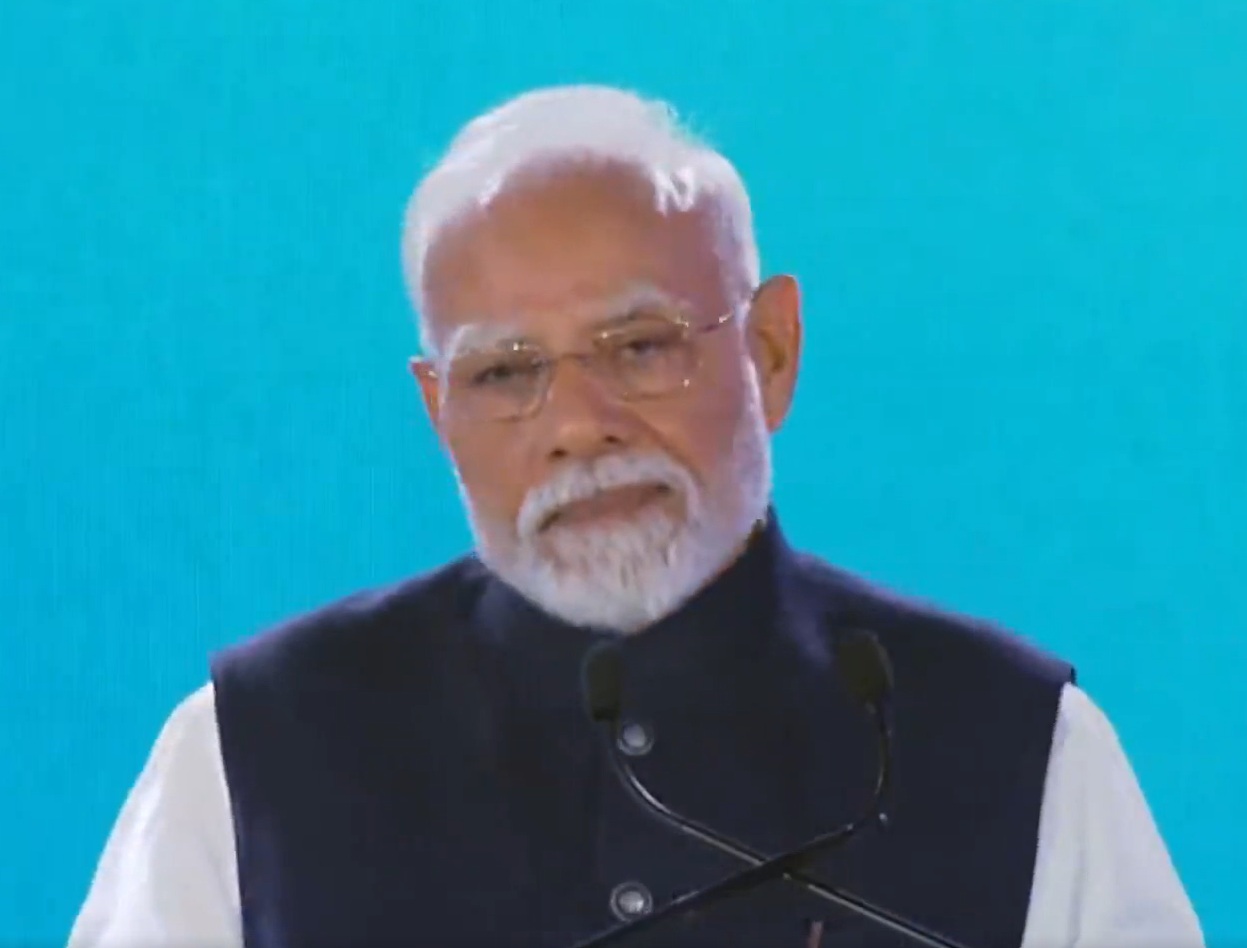
New Delhi, Oct 13 (UNI) Prime Minister Narendra Modi on Tuesday sought to position India as a reliable and stable partner in an increasingly uncertain world, asserting that the country's economic rise would create opportunities for others rather than come at their expense, and arguing that technology, innovation and governance reforms must serve the wider cause of inclusive growth and international cooperation.
Addressing the Bloomberg New Economy Forum in New Delhi, being hosted in India for the first time, Modi called for a fundamental rethink of the meaning and purpose of power as geopolitical conflicts, supply-chain disruptions, energy insecurity and technological competition reshape the global economic order. "For us, reforms are not a compulsion.
They are a conviction," the Prime Minister said, defending his government's economic agenda and seeking to reassure international business leaders and policymakers about India's growth prospects and policy direction. "We do not grow at anyone's cost. We grow with the world and for the world," he declared. "In a world full of uncertainties, India offers reliability and stability." The central theme of Modi's address was "Power to Empower", an idea he presented as an alternative to the traditional understanding of power as a means of control, competition or dominance.
He argued that the real measure of economic strength, technological advancement and political authority lay in their ability to enable others to prosper. "Today, technology is power, data is power, knowledge is power, innovation is power," he said, posing the question of whether these resources would remain concentrated in the hands of a few or be used to create opportunities for millions. "The real question is not who possesses power, but how it is being used," Modi said, advocating a transition from "power to control" to "power to enable", from "power to compete" to "power to collaborate", and from "power to succeed" to "power to help others succeed".
Drawing on an ancient Indian verse about the proper use of knowledge, wealth and strength, he maintained that the value of power depended on its purpose. He said India was seeking to translate this philosophy into governance, technological development and its engagement with the international community.
Welcoming the delegates, Modi thanked Bloomberg founder Michael Bloomberg for his longstanding association with India and his efforts to bring together global business leaders, economists and policymakers. He said the forum's focus on emerging centres of power was particularly relevant when the sources and definition of power were undergoing profound changes. Highlighting India's linguistic, media and digital diversity, Modi argued that democratic participation could be strengthened by widening access to information and technology.
He referred to the country's hundreds of languages, thousands of newspapers and publications, more than a thousand satellite television channels and hundreds of millions of digital platform users. The expansion of affordable mobile data and internet access over the past decade, he said, had transformed connectivity into an instrument of economic and social empowerment. Students in smaller towns could access digital learning, small traders could reach new customers, and young people could pursue online courses without being constrained by geographical barriers.
"Connectivity has not merely connected people; it has connected opportunities," Modi said, describing digital access as a means of widening participation in economic activity. He invited international delegates to experience India's digital payments ecosystem, arguing that a street vendor and a large automobile showroom could operate through the same digital infrastructure despite the vast differences in their scale of business.
India, he said, was prepared to share its digital public infrastructure with other countries, particularly those in the Global South, enabling them to develop systems suited to their own requirements. Modi cited the CoWIN platform, developed during the Covid-19 pandemic and made available as an open-source system, as an example of India extending its technological capabilities beyond its borders. "Our constant endeavour is to ensure that India's capabilities open new doors of opportunity for other countries as well," he said, presenting technology-sharing as a means of fostering international cooperation rather than creating dependence.
The Prime Minister also highlighted the expansion of the startup ecosystem, claiming that India had grown from having only a few hundred startups before 2014 to more than 250,000. Nearly half of these ventures, he said, originated in smaller cities and towns, while more than 45 per cent had at least one woman director or partner. These figures, Modi argued, demonstrated that innovation and entrepreneurship were no longer confined to established commercial centres and that a wider pool of talent was contributing to economic growth.
The benefits of innovation, he said, increased when more people had the opportunity to participate. Turning to governance, Modi maintained that the purpose of government authority should be to make citizens more capable and self-reliant rather than dependent on administrative systems. He claimed that approximately 250 million people had been lifted out of poverty in India over the past decade, describing the achievement as evidence of empowerment through public policy. He cited the Jan Dhan-Aadhaar-Mobile, or JAM, trinity and direct benefit transfers as examples of technology enabling government assistance to reach beneficiaries' bank accounts directly.
According to the Prime Minister, these mechanisms had reduced corruption, improved convenience and established a more direct relationship between citizens and the government. The same philosophy, he said, had informed India's international response during the Covid-19 pandemic, when equitable access to vaccines became a pressing global concern. Modi said India had supplied vaccines to more than 100 countries, allowing its manufacturing capacity to serve populations beyond its own borders. He also referred to discussions at the AI Impact Summit held in India earlier this year on using artificial intelligence for the benefit of humans and animals.
Technological advancement, he argued, should be measured not merely by the sophistication of applications but also by the range of people and living beings that benefited from them. "Power is not just the ability to move ahead. It is also the ability to empower others to move ahead," he said, arguing that competition needed to be accompanied by compassion, innovation by a wider distribution of benefits, and national strength by contributions to solving global problems. Climate change, water governance, public health and the responsible use of emerging technologies were among the areas where he said international cooperation was essential to developing solutions that created opportunities instead of deepening divisions.
On climate action, Modi cited India's commitment under the Paris Agreement to derive 40 per cent of its installed electricity capacity from non-fossil fuel sources by 2030. He said the target had been achieved in November 2021, nine years ahead of schedule, making India the first G20 country to meet that particular commitment. He added that the country's renewable energy capacity had increased from approximately 75 gigawatts in 2014 to around 300 gigawatts, representing an almost fourfold expansion.
The growth, he said, was generating fresh economic opportunities while supporting the energy transition. The PM Surya Ghar and PM-KUSUM schemes, which promote solar power in households and the agricultural sector respectively, were also cited as examples of combining environmental objectives with economic empowerment.
Modi said the initiatives had helped add more than 30 gigawatts of solar capacity and were expected to reduce carbon emissions by over 30 million tonnes annually. The Prime Minister then turned to the mounting pressures confronting the global economy, including the pandemic, wars in different regions, trade disruptions, restrictions affecting critical minerals and vulnerabilities in energy supplies.
Countries, he said, were increasingly being confronted with successive crises before they could fully recover from the previous ones. "Things that once connected the world are today becoming weapons," he said, referring to supply chains, energy, minerals, payment systems and technology as potential instruments of pressure and dominance. Globalisation had created interconnected networks that were increasingly turning into strategic chokepoints, Modi argued, while artificial intelligence was transforming industries and ageing populations were posing additional challenges for many economies.
Against this backdrop, trust had become indispensable to international economic relations. The world needed confidence that supplies would remain available during crises, that commitments would be honoured and that partner countries would stand together when circumstances became difficult, he said. Modi sought to present India as a dependable contributor to such stability, pointing to its pharmaceutical industry, digital infrastructure, skilled workforce and global business services sector.
He said one in every five generic medicines worldwide came from India, while Indian-developed digital identity and payment systems were attracting international attention. He also cited the presence of more than 2,000 global capability centres in India, providing services to companies across the world. These operations, he said, reflected the growing integration of Indian talent and infrastructure into international business networks. "Whenever the world needs a steady pillar, India steps forward, understanding its responsibility," he said, reiterating that the country's economic expansion was intended to complement, rather than undermine, global prosperity.
The Prime Minister argued that India's international initiatives reflected this commitment to shared progress. He cited the International Solar Alliance, the Coalition for Disaster Resilient Infrastructure, the International Big Cat Alliance, the Global Biofuels Alliance, the India-Middle East-Europe Economic Corridor and the Mission LiFE initiative as examples of platforms and programmes intended to address challenges extending beyond national boundaries. He also invoked the principles of "One Sun, One World, One Grid", "One Earth, One Family, One Future" and "One Earth, One Health", saying India's approach was to build connections and encourage cooperation rather than use its growing capabilities to establish dominance.
Modi added that India had never sought royalties for giving the world the concept of zero, using the example to underline what he described as the country's tradition of sharing knowledge for the benefit of humanity. Turning to the domestic economy, the Prime Minister cited growth of 7.8 per cent in the April-June quarter, arguing that the expansion was underpinned by stronger economic fundamentals. He contrasted a current account deficit exceeding 4 per cent of gross domestic product 12 to 13 years ago with a figure of approximately 0.61 per cent in the previous year.
He also pointed to foreign exchange reserves exceeding $700 billion and described the banking system as being in its strongest position in decades. Improvements in India's sovereign credit ratings, he said, reflected growing confidence in the economy. Modi highlighted the Goods and Services Tax as a major reform that had replaced a complex network of indirect taxes with a national market. He also cited insolvency legislation, the consolidation of 29 labour laws into four labour codes and the decriminalisation of hundreds of minor business-related offences as evidence of the government's efforts to improve the business environment. Reforms, he said, would continue to be pursued as a matter of conviction rather than undertaken merely in response to economic pressures.
"For us, reforms are not a compulsion. Reforms are our conviction," he reiterated. Invoked an ancient Vedic verse, Modi called on people to walk together, speak together and develop a shared understanding. International cooperation, he said, was indispensable because no country could resolve all the challenges confronting humanity on its own. "Let us walk together. Let us speak together. Let us strive to understand one another," he said, arguing that collective effort strengthened capabilities, dialogue improved understanding and mutual trust made it possible to find solutions to common problems. The address combined a defence of India's economic performance and reform agenda with a broader argument about the country's role in a changing international order. By presenting technology, economic strength and governance as instruments of empowerment, Modi sought to make the case that India's rise should be measured not only by domestic growth but also by the opportunities it could create for other nations. His central message to the international business and policy community was that, amid geopolitical uncertainty and intensifying competition for strategic resources, India intended to emerge as a partner offering stability, expanding capabilities and a model of growth based on shared opportunities rather than zero-sum competition. UNI SKA ARN


