


Cabinet clears Rs 7,396-cr rural governance plan to empower 2.55 lakh Panchayats
New Delhi, Oct 28 (UNI) The union Cabinet on Wednesday approved the Pradhan Mantri Viksit Gram Swaraj Yojana (PM VGSY), a Centrally Sponsored Scheme with an outlay of Rs 7,395.55 crore for 2026-27 to 2030-31, aimed at strengthening grassroots governance, empowering Gram Panchayats and aligning national development priorities with the needs and aspirations of rural communities.
Announcing the decision after the Cabinet meeting, Information and Broadcasting Minister Ashwini Vaishnaw described the initiative as a next-generation governance transformation programme aligned with the national vision of Viksit Bharat. The scheme, which will run concurrently with the Sixteenth Finance Commission period, seeks to build the institutional, administrative and digital capacities of more than 2.55 lakh Gram Panchayats and traditional rural local bodies.
Around 32 lakh elected representatives, Panchayat functionaries and other stakeholders are expected to benefit directly from its capacity-building initiatives, while each coordinated public awareness exercise is expected to reach at least one crore citizens. Of the total outlay, the Centre will contribute Rs 4,869.48 crore, while the States will provide Rs 2,526.07 crore.
The scheme will cover all States and union Territories, including traditional rural governance institutions in areas where Panchayats do not exist under Part IX of the Constitution. A key objective of PM VGSY is to transform Gram Panchayats into focal points of integrated local development planning, moving beyond the fragmented implementation of individual government schemes.
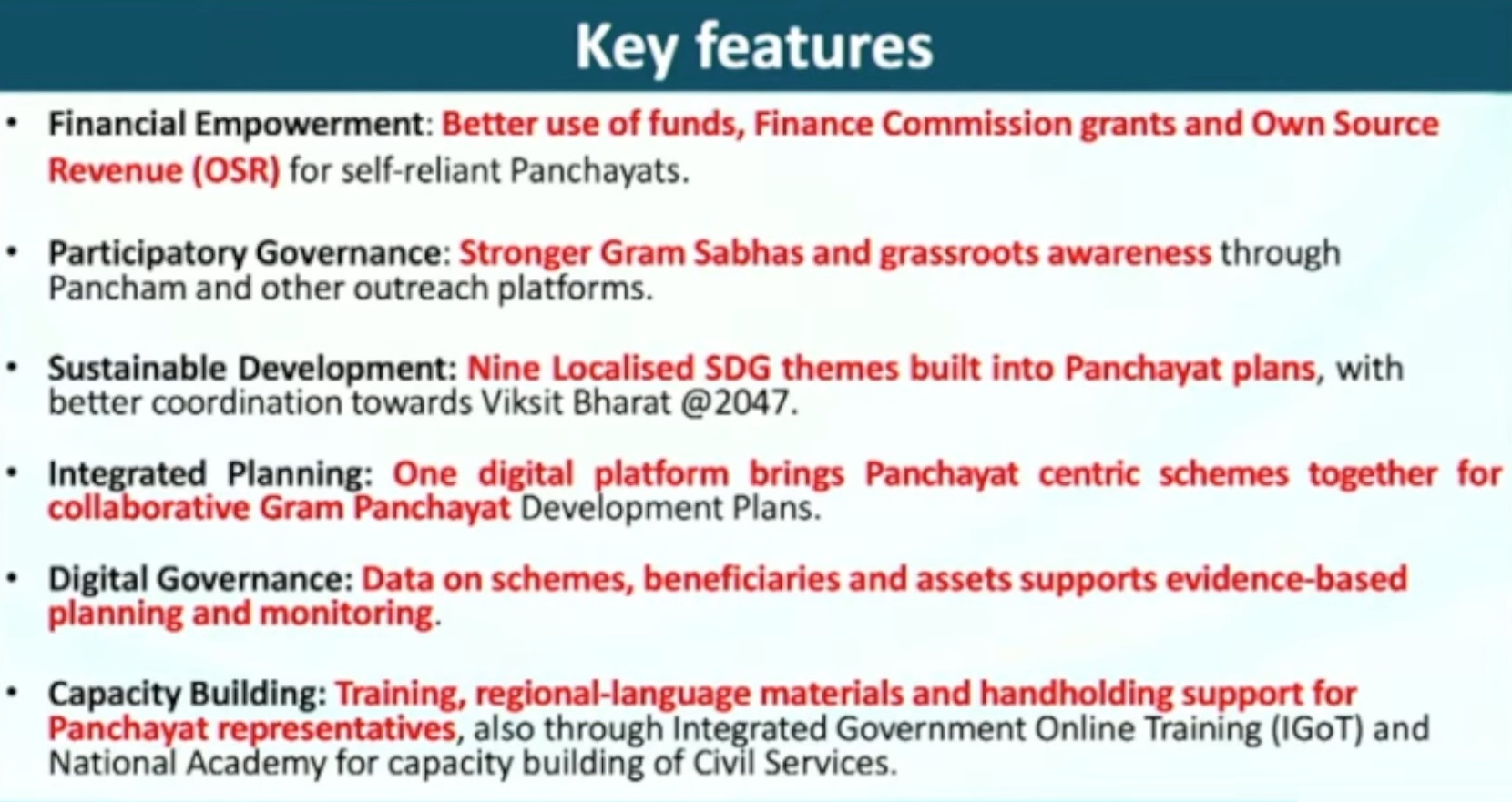
The programme will bring together village-level priorities, interventions by Central and State government departments and available financial resources on a common digital platform, enabling Panchayats to identify development gaps, improve coordination and deploy funds more effectively. The initiative assumes particular significance in view of the Sixteenth Finance Commission's recommendation of approximately Rs 4.35 lakh crore in grants for Rural Local Bodies during 2026-27 to 2030-31.
The scheme seeks to equip Panchayats with the planning, technical and administrative capabilities needed to translate these grants, along with government programme allocations and local contributions, into tangible improvements in village infrastructure and public services. Under the programme, at least 2.55 lakh comprehensive Gram Panchayat Development Plans will be prepared annually through the eGramSwaraj Portal.
These plans will incorporate local priorities, relevant Central and State government interventions and the financial resources available to Panchayats, including Finance Commission grants. Existing mechanisms for delivering individual government schemes will continue, but the new framework is intended to improve coordination and ensure that development interventions complement one another.
Building on eGramSwaraj and existing e-Panchayat systems, PM VGSY will provide a consolidated picture of development-related information at the Gram Panchayat level. Details of government schemes, beneficiaries, benefits, community assets and available resources will be brought together digitally to help local bodies assess needs, identify gaps and monitor progress. The emphasis will be on making information more accessible and strengthening evidence-based planning and decision-making. Public participation and awareness will form another important component. The scheme will use existing training, digital and outreach platforms, Gram Sabhas and other Panchayat forums to improve citizens' understanding of government programmes and national development initiatives. The AI-enabled, multilingual PANCHAM platform, which supports two-way communication in 17 Indian languages, will be used to explain schemes in accessible language and encourage informed discussions about their relevance to local development. The government expects each coordinated awareness-generation exercise to reach at least one crore citizens. By connecting national priorities with village-level discussions, the programme aims to help rural communities understand available opportunities and ensure that their aspirations are reflected in local development plans. Capacity building will be undertaken on an annual basis, with around 32 lakh elected representatives, Panchayat functionaries and other stakeholders receiving training and digital support. The programme will focus on improving their ability to use digital platforms, interpret information on schemes and resources, prepare integrated development plans, communicate with citizens and work towards locally relevant Sustainable Development Goals. Financial transparency and greater self-reliance of Panchayats will also be prioritised.
The scheme envisages the preparation of at least 2.55 lakh online audit plans annually and the timely completion of corresponding audits through AuditOnline. Improved accounting practices, public disclosure and mobilisation of own-source revenue are expected to strengthen oversight of public expenditure, promote accountability and gradually reduce excessive dependence on external grants.
The government expects the integrated approach to improve the utilisation of Finance Commission grants and other available resources, address gaps in basic services and development infrastructure, and establish a closer link between public expenditure and locally identified needs. By combining digital information, coordinated planning, public participation and financial accountability, the scheme seeks to make rural local bodies more effective institutions of governance.
PM VGSY will be implemented through State governments and union Territory administrations, which will submit annual action plans detailing proposed activities, priorities and resource requirements in accordance with the scheme's guidelines. A designated Central Empowered Committee will appraise and approve these plans under the prescribed procedures and norms.
The Centre, States and union Territories will undertake activities within their respective areas of responsibility, supported by coordination, technical assistance, monitoring and periodic reviews. The programme will rely largely on existing institutional arrangements, digital infrastructure, communication channels and capacity-building systems. No permanent posts will be created under the scheme, although need-based contractual personnel may be engaged at the State, district and block levels to provide technical and institutional support.
The initiative comes amid wider efforts to strengthen decentralised governance and improve the delivery of rural development programmes. Its underlying objective is to ensure that national reforms, government schemes and enhanced financial resources translate into measurable improvements in villages, with Gram Sabhas and Panchayats playing a central role in identifying priorities, coordinating interventions and monitoring outcomes.
By placing integrated planning, citizen participation, digital governance and transparent financial management at the heart of rural administration, PM VGSY seeks to bridge the gap between the broader Viksit Bharat vision and the everyday development needs of rural communities over the five-year period ending in 2030-31.
UNI SKA AAB


