


BRICS 2026: India positions itself at the Centre of a multipolar world
Shahid K Abbas
New Delhi, Sep 13 (UNI) The 18th BRICS Summit in New Delhi has emerged as far more than a routine meeting of emerging economies. It has provided a revealing snapshot of a world in transition, where economic weight, diplomatic influence and political agency are steadily moving beyond the traditional centres of Western power.
With its expanded 11-member grouping representing roughly half of the world's population and about 41 per cent of global GDP, BRICS can no longer be viewed simply as a loose coalition of developing economies seeking a greater voice. It is increasingly becoming one of the principal platforms through which the contours of an emerging multipolar order are being debated and defined. The significance of the New Delhi summit therefore extended well beyond its formal themes of development, innovation, sustainability and cooperation.
At its heart was a much larger question: who gets to shape the rules of the international system? In aggregate demographic and economic terms, the enlarged BRICS grouping has acquired a scale that enables it to rival, and in several respects outpace, the traditional G7 framework. The comparison is not merely about population or GDP. It points to a deeper structural transformation in which countries of the Global South are increasingly unwilling to remain rule-takers in an international system whose principal institutions were designed in a very different geopolitical era. Yet perhaps the most consequential feature of the New Delhi summit was not the numerical strength of BRICS but India's role in translating that collective weight into diplomatic relevance.
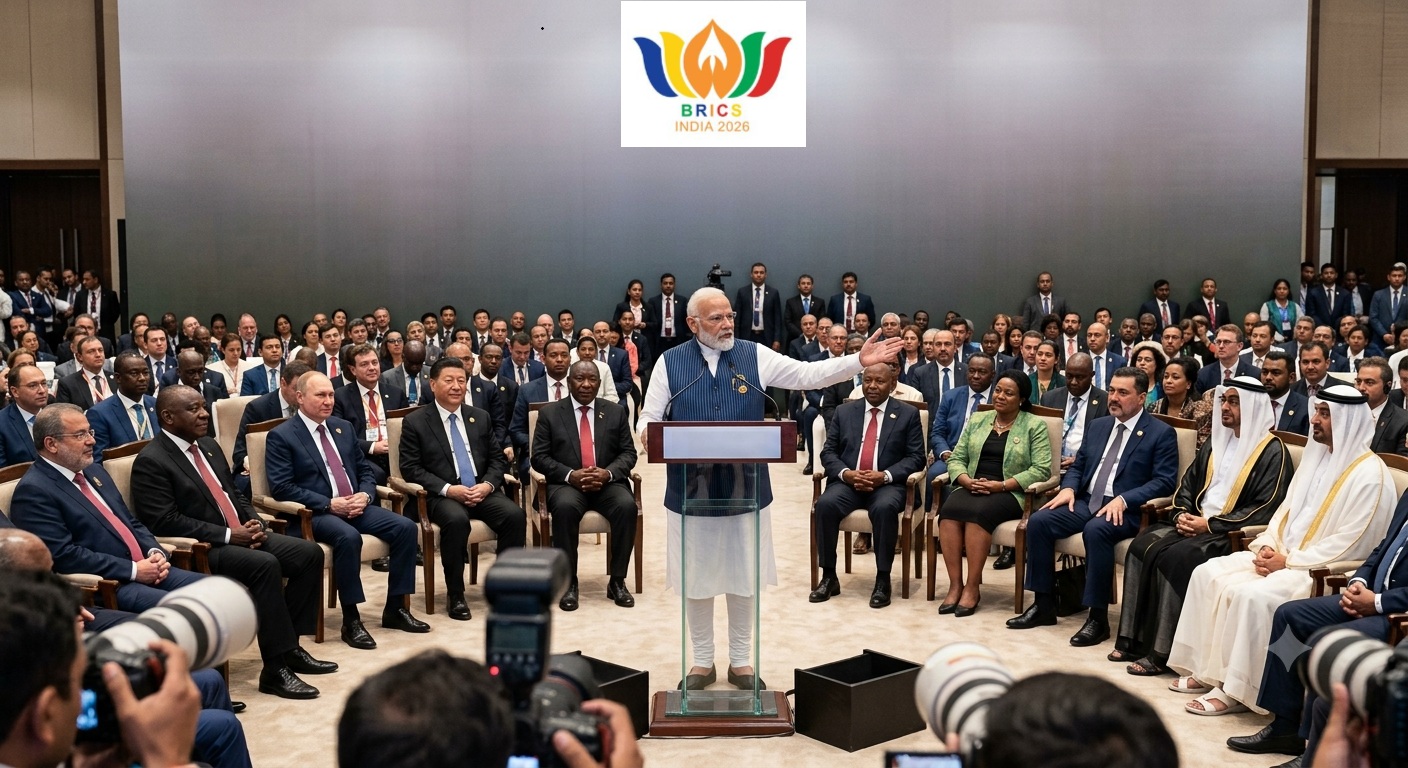
Prime Minister Narendra Modi was at the centre of an unusually intricate balancing exercise. New Delhi hosted Chinese President Xi Jinping on his first visit to India in seven years, while maintaining its strategic relationship with Russia and engaging an expanded BRICS membership that includes countries such as Iran. At a time when several BRICS members themselves have strategic rivalries, territorial disputes and competing regional ambitions, India's ability to keep the grouping focused on areas of common interest was a diplomatic achievement in its own right. India's approach has increasingly positioned it as a bridge between competing geopolitical worlds rather than as a camp follower of any single power centre.
Its partnerships with the United States and Europe coexist with long-standing ties with Russia, an increasingly consequential engagement with the Global South and a complex but indispensable relationship with China. The New Delhi summit demonstrated the practical value of that strategic autonomy. India was able to bring together countries with markedly different political systems, strategic priorities and perceptions of the international order while preserving the central BRICS proposition: that emerging economies should have a greater say in global decision-making.
That balancing act assumed particular importance during negotiations over the New Delhi Declaration. The consensus document demonstrated that BRICS could absorb significant disagreements without allowing them to fracture the collective platform. Regional tensions, particularly those surrounding the Middle East and the difficult relationships among some of its members, provided a formidable test. The fact that the enlarged grouping was able to produce a common declaration despite such competing interests underscored BRICS' growing importance as a diplomatic forum. For India, the summit was particularly significant because it enabled New Delhi to connect the broader argument over global governance with issues central to its own strategic concerns. The declaration's emphasis on terrorism, including condemnation of cross-border terrorism and the networks that finance it, provided India with an important diplomatic opening.
New Delhi has consistently maintained that terrorism cannot be divided into convenient categories of acceptable and unacceptable violence and that there can be no double standards in combating the menace. Securing collective language on the issue within an enlarged grouping whose members have sharply different geopolitical relationships was consequently a notable diplomatic gain for the host country. The economic dimension of the summit was equally consequential. BRICS discussions on increasing the use of national currencies in trade and exploring alternatives to existing international financial arrangements point towards a gradual effort to reduce excessive dependence on the US dollar-dominated system.
This does not signify the overnight creation of a rival global financial architecture, nor does it suggest that the dollar can readily be displaced. But the direction of travel is clear. Emerging economies want greater protection from financial shocks, unilateral sanctions and vulnerabilities arising from dependence on institutions and currencies over which they exercise limited control. The argument for greater financial diversification is therefore as much about sovereignty as economics. Wider use of local currencies and alternative payment mechanisms could eventually give BRICS members additional room for manoeuvre in international commerce.
For developing economies, such arrangements are attractive not merely because they could lower transaction costs, but because they could create a broader financial space in which national economic choices are less vulnerable to external political pressure. This is why the BRICS debate over de-dollarisation needs to be approached with realism rather than rhetoric. The grouping does not possess a common currency, a fully integrated financial market or an alternative system capable of replacing the dollar-based architecture. The dollar remains deeply embedded in global trade and finance. But creating alternatives does not require the immediate replacement of the existing system. Even incremental diversification can alter bargaining power. In that sense, BRICS is seeking not necessarily to dismantle the existing financial order but to reduce the international economy's dependence on a single dominant currency and institutional ecosystem.
The larger political significance of BRICS lies in its capacity to provide an additional bridge between the Global North and the Global South. Its members include major energy producers, manufacturing powers, populous developing economies and countries occupying critical geopolitical crossroads. Their interests are often divergent, but they share a broad dissatisfaction with the unequal distribution of influence within global institutions. The group's expanding membership consequently gives developing countries another platform from which to press for reforms in institutions such as the United Nations Security Council and the wider international financial architecture.
The New Delhi summit also carried a distinctly Indian imprint. The emphasis on development, innovation, sustainability and a people-centric approach reflected New Delhi's attempt to portray BRICS not simply as a geopolitical counterweight to the West, but as a practical platform for addressing the concerns of ordinary people across developing countries. India's framing of its BRICS presidency around "Humanity First" reinforced the effort to give the grouping a more inclusive and development-oriented narrative. There was, moreover, a cultural and domestic Indian dimension to the summit's presentation. The projection of New Delhi as the host of an increasingly influential Global South platform formed part of what could be described as India's "Vocal for Local" diplomacy - projecting Indian cultural identity, heritage and developmental experience while placing India at the centre of an international conversation. The message was that global leadership does not have to mean cultural homogenisation. India's soft power can operate alongside its hard strategic interests.
Ultimately, the significance of BRICS 2026 lies in the tension between its growing collective weight and its extraordinary internal diversity. Its members do not constitute a conventional alliance and are unlikely to agree on every major geopolitical question. Nor can economic strength automatically be converted into political unity. But that may precisely be the grouping's emerging character: not a Western-style alliance, but a flexible platform through which countries with very different interests can coordinate wherever their interests converge. New Delhi has demonstrated that India's influence in this evolving architecture derives not merely from being one of BRICS' largest members, but from its capacity to convene, negotiate and bridge competing positions. By bringing Xi Jinping to India while maintaining its relationship with Vladimir Putin, engaging Iran and other new members, and simultaneously retaining strategic partnerships with Western powers, Modi has sought to demonstrate that India's foreign policy is built around autonomy rather than alignment.
The New Delhi summit, therefore, was less about the birth of an anti-Western bloc than about the emergence of a world in which no single bloc can comfortably claim to represent the international community. BRICS may not yet provide a comprehensive alternative to the Western-led order, but its expanding economic weight, diplomatic reach and appetite for institutional reform make it increasingly difficult for the established powers to ignore. The message from New Delhi was consequently larger than BRICS itself. The Global South wants a seat not merely at the table, but a voice in deciding how the table is designed. India, at this summit, sought to establish itself as one of the principal bridges between that aspiration and the existing global order - and, in doing so, to position New Delhi not on the margins of the emerging multipolar system, but increasingly at its centre.


