


Orissa HC refuses blanket ban on religious pandals on public roads, stresses unhindered public access
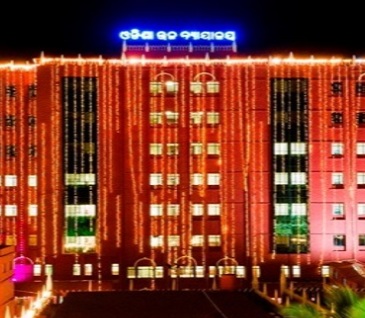
Bhubaneswar, Oct 19 (UNI) The Orissa High Court has declined to impose a blanket ban on temporary religious pandals on public roads, observing that religious festivals may be held in the larger public interest as long as they do not completely obstruct traffic, restrict residents' access to their homes or impede emergency vehicles.
The Court held that the larger public interest in community celebrations outweighs individual inconvenience, provided the arrangements do not completely block traffic or deny residents access to their homes. A Division Bench of Chief Justice Harish Tandon and Justice Mruganka Sekhar Sahoo disposed of a public interest litigation (PIL) filed by Sarat Kumar Gajendra, who alleged that a temporary pandal erected for Ganesh Puja or Durga Puja about 50 metres from his house had completely blocked the road, making access to his residence difficult.
The Bench held that the right to practise religion under Article 25 of the Constitution is subject to reasonable restrictions in the interests of public order, morality and health. It observed that community religious festivals are integral to the country's cultural traditions and that individual inconvenience cannot, by itself, justify stopping such celebrations.
The court noted that the State had maintained in its affidavit that a 22-foot passage was being kept open at the site to facilitate vehicular movement. Finding no ground to issue a writ of mandamus, the Bench declined to intervene against the conduct of the festivals. It, however, directed the authorities to ensure that permissions for temporary pandals are granted only with adequate space for vehicular movement and uninterrupted access to residents' homes.
Sufficient clearance must be maintained for emergency vehicles, including ambulances and fire engines. The court also directed the authorities to enforce prescribed sound limits and time restrictions and ensure that temporary structures on public roads do not unduly obstruct movement.
Disposing of the PIL, the Bench appreciated the petitioner for highlighting concerns over public access and safety, emphasising that religious celebrations must not result in complete disruption of traffic or denial of ingress and egress to residents.
UNI AAB


