


Hyundai's $15.5bn bet puts India on the fast lane to global car manufacturing
Ninad D Sheth
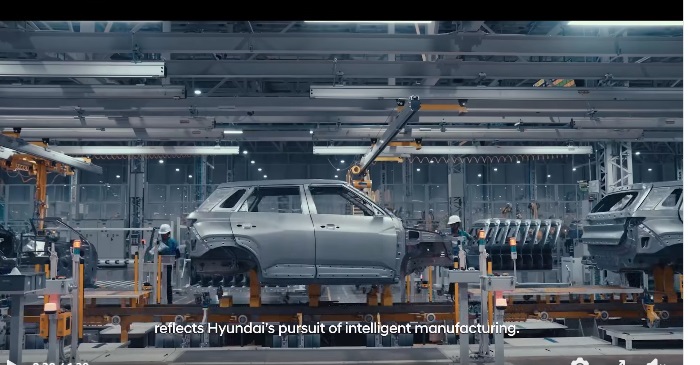
new Delhi, Oct 15 (UNI) Hyundai Motor Group's $15.5bn investment commitment through 2032 vrooms the make in India engine. It could potentially help India capture higher-value stages of automotive production, from component engineering throgh vehicle research and development. All this while using domestic scale to lower unit costs and make Indian-made cars more competitive globally. The significance lies in the scale and breadth of the commitment: manufacturing expansion, local component suppliers, engineering R&D , and significantly the future mobility businesse, Euisun Chung, Executive Chair, Hyundai Motor Group had said at the announcement, "This investment reaffirms our commitment to India for the next 30 years and beyond."
Significantly, Hyundai and Kia already have combined annual production capacity exceeding 1.4m vehicles in India. Building on that base, the group is investing in an automotive ecosystem whose competitive advantage can extend well beyond the cars sold to Indian consumers. It is not well know that In car manufacturing and especially in small cars India is already the world's fifth largest exporter. In 2025 India exported an estimated $118 billion in cars.
The domestic car market has a long runway
The family car was a dream Manifested by Suzuki. The achievement was to create India's mass-market car industry almost from scratch. When the Maruti 800 arrived in 1983, it made car ownership attainable for households previously priced out of the market, then built an ecosystem of suppliers, service centres and dealers around the promise of affordable, dependable motoring. From those early days zoom to 2025 when a staggering 4.5 million passenger vehicles including cars and vans were sold in India.
Hatchback Nation
Four decades after Suzuki, the Indian customer has become more demanding, but the old constraint remain. In India, aspiration routinely outruns purchasing power. SUVs accounted for roughly 56% of passenger-vehicle sales in 2025, yet they are at best hatchbacks disguised as SUV's. On the menu basic higher ground clearance for broken roads, a commanding driving position, family practicality (packing six people) and the social status attached to a larger vehicle. Manufacturers have responded by concentrating on more expensive vehicles, where margins are fatter; premiumisation.
Hyundai investments have not come from thin air . It has a history of belief in the Indian market !
Hyundai's success in India rests on three mutually reinforcing strengths. First, it has repeatedly matched its product range to changing tastes: from the Santro's challenge to Maruti's small-car dominance to the Creta's success in the SUV market, it has built nameplates around identifiable consumer needs. Second, it has combined competitive pricing with features, design and cabin quality that make its cars feel more expensive than they are-a powerful proposition for aspirational buyers who scrutinise both the monthly instalment and the badge on the bonnet. Third, it has invested in local manufacturing, supplier relationships, dealerships and after-sales service, allowing it to compete on availability and ownership costs as well as the showroom experience.
The Honda City illustrates the cost of losing touch with a market's changing preferences. Once a benchmark in the mid-sized sedan segment, it sold just 10,901 units in the financial year 2024-25, down from 16,925 the year before. Three forces explain the retreat: buyers increasingly favour SUVs' higher seating and perceived practicality. Moreover, the sedan segment has shrunk sharply as manufacturers redirect attention towards utility vehicles; and rivals have offered customers newer body styles and more conspicuous features. The City retains a reputation for refinement and reliability, but brand equity cannot indefinitely compensate for a change in what buyers want. The international lesson is familiar: Volkswagen's success with the Golf in Europe rested on continual product renewal within a recognisable formula, while its global SUV expansion reflected the need to follow consumers as tastes changed. Hyundai's investment will pay off if it preserves that same responsiveness in India-serving the budget-conscious first-time buyer while developing the SUVs, technology and engineering capabilities that can sustain higher margins and exports.
India's domestic market gives this strategy considerable runway. The country has only about 30-35 cars per 1,000 people, leaving ownership far below levels in advanced economies. Rising incomes, urbanisation and households moving from two-wheelers to cars create a substantial long-term opportunity, although affordability and uneven purchasing power will determine how quickly it materialises. The global opportunity is already measurable: India exported 863,233 passenger vehicles in calendar 2025, up 16% year on year. Maruti Suzuki shipped a record 395,000 vehicles, while Hyundai was among the leading exporters; in financial year 2025-26, Hyundai's exports reached roughly 190,000 vehicles. Compact cars, sedans and increasingly compact SUVs made in India are finding buyers across Africa, the Middle East and Latin America. Hyundai can use Indian plants to serve these markets with competitive production costs, an established supplier base and models engineered for price-sensitive customers. Its investment therefore hedges two growth opportunities at once: rising Indian demand and a larger export role for India in Hyundai's global manufacturing network.
The most consequential part of the announcement may be the $700m earmarked for research and development. Hyundai plans to expand its Indian R&D centre, establish a vehicle-testing track and build a more complete development capability for next-generation vehicles. Its existing engineering operation in Hyderabad works with Hyundai's central R&D hub in South Korea; the group has also been building research partnerships with Indian universities in battery and electrification technologies. This is a move from adapting globally developed cars to Indian conditions towards developing more of the technology and engineering solutions in India. Local teams can test vehicles against Indian heat, monsoon conditions, road surfaces, traffic and cost constraints, then apply the resulting expertise to compact vehicles for other emerging markets. The economic multiplier is potentially substantial: advanced engineering creates demand for specialised talent , electronics and software.
In India Hyundai already maintains an original equipment manufacturer (OEM) localization level of roughly 83% to 92% some parts like specific high-end or niche automatic transmissions are imported. The massive $15.5 billion investment will deepe its broader product portfolio. India stands to gain from intellectual property, supplier capability and export-oriented engineering that this investment leaves behind.
(The author is a senior journalist with over 25 years of experience.)
UNI XC AAB


